-Mohamed Alloush
Military data and statements issued recently by the enemy Israeli army indicate the beginning of a ground operation in Lebanon, but it appears that it will be gradual after a large military buildup on the border.
Israeli estimates talk about the possibility of up to five military divisions participating in this operation, while the declared goal is to expand what Israel calls the “security zone” north of the border, that is, pushing the engagement lines deeper into Lebanese territory, in addition to destroying the resistance’s military infrastructure in the border villages and towns. These goals are officially presented in Israeli military and political discourse, but they remain general formulations. For years, Israel has deliberately reduced the level of announcing its actual operational objectives to avoid repeating the experience of previous wars, where declared objectives turned into a direct criterion for measuring failure or success.
In this context, it is possible to understand the ongoing military buildup on the border. The Israeli army does not move with one division, but rather the roles are distributed among several formations. Among these formations, the 98th Division stands out, which is considered one of the mobile attack divisions. It includes paratroopers and commando units and is usually used in rapid operations, deep incursions, and dealing with street and tunnel wars. The role of this division, according to Israeli doctrine, is to carry out limited penetration operations and control strategic points or specific villages for short periods of time, while relying on rapid movement and maneuverability.
Next to it appears the 36th Division, which is one of the main armored divisions in the Israeli army. This division relies on tank and heavy armor brigades, and is usually used in ground operations that require stabilizing lines of control or securing areas being occupied on the ground. Its presence in any ground operation means that the IDF poses the possibility of expanding the scope of the ground engagement.
There is also talk of the participation of the 91st Division, which is the division primarily responsible for the Lebanon front within the Northern Command.
The role of this division is related to managing the border sector itself and coordinating operations between the various units, in addition to operating field monitoring and intelligence systems.
In some Israeli military estimates, the possibility of involving the 146th Division, an armored reserve division usually used to reinforce regular forces in the event of expansion of operations, is also raised, in addition to the 162nd Division, which is one of the heavy divisions used in large-scale ground operations.
The Israeli enemy realizes that entering deeper into southern Lebanon carries great military risks, especially since the experience of previous wars has shown the difficulty of controlling areas full of villages and a complex geographical environment.
On the other hand, the resistance’s approach appears different from that adopted in previous rounds of fighting. During the border confrontations in 2024, a large part of the military effort was focused on preventing any Israeli ground advance, that is, turning every incursion attempt into a direct defensive battle on the line of contact. At the current stage, field indicators suggest that combat doctrine has become more flexible.
Instead of always seeking to stop the Israeli advance at the first point, incursions are treated as an opportunity to exhaust advancing forces. This means focusing effort on ambushes, hitting vehicles, and targeting units that enter open or isolated areas.
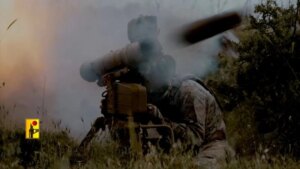
One of the most important elements of strength in this type of confrontation is anti-armor guided missiles. These missiles, which in some types have a range of ten to twelve kilometers, give small groups the ability to target tanks and vehicles from relatively long distances. With the presence of a field monitoring network that relies on direct observation and technical means, any force moving within these distances becomes vulnerable to targeting.
In addition, resistance groups rely on spreading within multiple lines of defense rather than a single line of defense. This pattern allows avoiding the depletion of core strength in the first phase of incursions, and makes Israeli forces vulnerable to successive strikes as they advance deeper.
According to informed military sources, the potential Israeli ground operation is governed by a complex equation. Israel seeks to create a new security reality on the border by expanding the separation line and destroying part of the nearby combat structure, while the resistance is betting on turning any ground incursion into a long and costly battle of attrition, based on striking the advanced forces and forcing them to fight within an uncomfortable geographical environment, which makes them retreat and stop. She pointed out that for this specific reason, the course of any ground operation in the south is determined by the ability of each party to impose the style of fighting that it desires. It suits him.