In a position that reflects the Lebanese government’s view of the current events, Minister of Justice Adel Nassar stated that the Lebanese state is the only body authorized to make decisions about war and peace, considering that Hezbollah’s actions constitute a clear violation of the law and the country’s involvement in a regional conflict that does not serve its interests.
Nassar made these statements during an interview with Christiane Amanpour, a CNN anchor, where he explained the Lebanese government’s position on the issue of weapons outside the authority of the state and the consequences of the current military confrontations.
Nassar stressed that the Lebanese government has taken a firm stance since its formation, which was evident in the ministerial statement presented to the House of Representatives, which categorically affirms the necessity of restricting power and weapons to the hands of the state only.
He pointed out that Lebanon had long suffered from the existence of a parallel military structure operating outside the scope of the state’s authority, explaining that Hezbollah sought during this period to develop and strengthen its military capabilities, which complicated the process of the state restoring its security and military control.
He added that the Lebanese state considers that achieving internal stability and building the state requires applying the principle of arms monopoly, stressing that this represents a basic condition for protecting the country’s supreme interests.
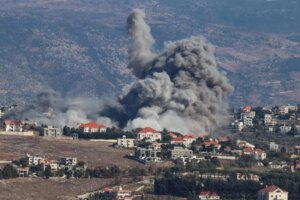
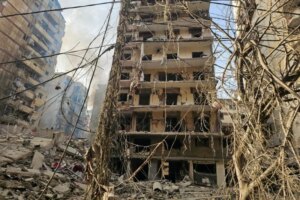
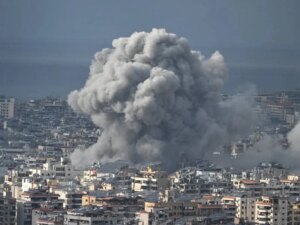
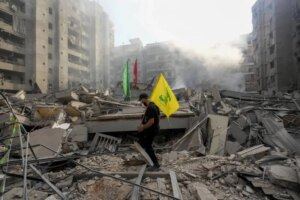
The Minister of Justice stated that Hezbollah’s failure to cooperate with the state in this regard led to a worsening of the internal situation, noting that the continued presence of a military structure outside the framework of the state gives Israel justifications to launch military attacks on Lebanon.
He explained that the decision to launch missiles towards Israel was taken unilaterally, which gave a pretext to expand the scope of the military confrontation.
He said that Lebanon had previously witnessed intermittent strikes, but this development led to the situation turning into a large-scale war.
Nassar stressed that Lebanon’s ability to confront Israel diplomatically depends directly on the state alone having the decision to make war and peace.
He added that the Lebanese government considers that confining weapons to the state is a national necessity to protect Lebanon and defend the interests of all Lebanese, noting that the presence of a parallel force that makes strategic decisions outside state institutions weakens the government’s ability to move politically and diplomatically.
He also stressed that Hezbollah’s actions represent a violation of the law and the obligations undertaken by the state towards its people, which are based on ending the existence of any parallel party that takes decisions on war and peace unilaterally.
In the context of his speech, Nassar believed that the party’s current positions and behavior indicate that it seeks to play a prominent role in the ongoing regional war between Israel and the United States on the one hand and Iran on the other.
He stressed that Lebanon’s interest lies in staying away from regional conflicts and adopting a policy of dissociation, pointing out that Lebanon is a small, multi-sectarian country, and that its stability depends on maintaining the model of coexistence and internal peace.
He concluded his speech by saying that Lebanon should be a model of peace and coexistence, and not an arena used in other people’s wars.