The New York Times warned that Lebanon today stands at a sensitive “turning point” with the escalation of the confrontation between Hezbollah and Israel, at a time when pressure is increasing on the Lebanese government to take decisive steps to limit the party’s influence and disarm it.
According to a report prepared by journalist Christina Goldbaum from Beirut, the Lebanese state has tried over the past year to walk a delicate rope in its dealings with Hezbollah: responding to pressure from the United States and its allies to move against the party, while avoiding a direct clash that might spark a civil war within the country.
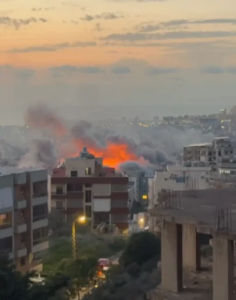
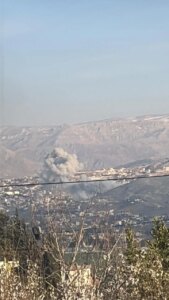
But this balance began to crack with the outbreak of a new round of fighting. In recent hours, the Israeli army launched intensive raids on the southern suburb of Beirut, Hezbollah’s stronghold, which led to the displacement of thousands of residents from the area, with many of them spending the night in the streets of the center of the capital.
In this context, Sami Nader, director of the Institute of Political Science at Saint Joseph University in Beirut, said that the country has reached a “moment of transformation,” adding: “Either we go to a dark scenario where a clash erupts between the Lebanese army and Hezbollah, or the party adheres to the government’s decision and disarms.”
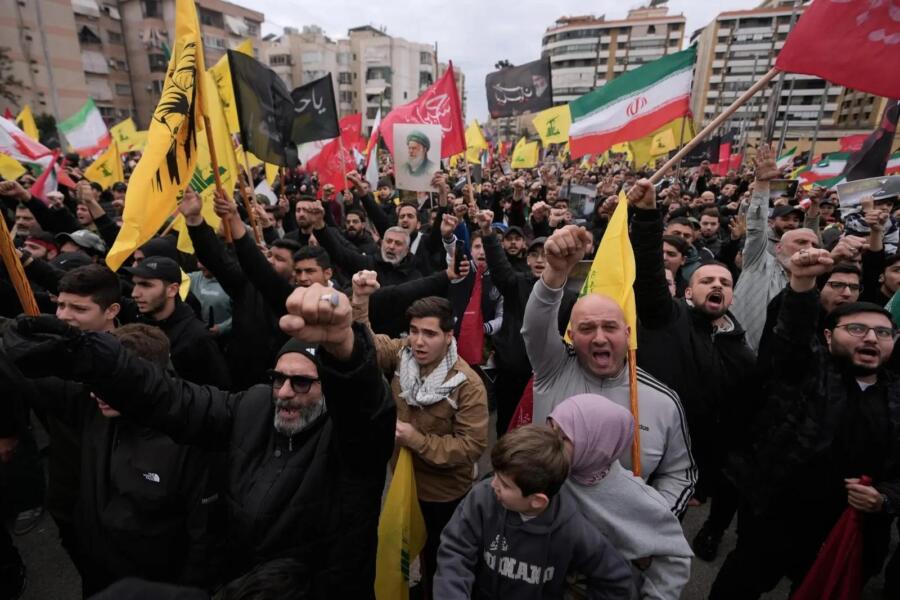
The report indicates that the current escalation began after Hezbollah launched missiles at Israel this week in response to the killing of Iranian Supreme Leader Ali Khamenei, which opened a new battle front and changed the political calculations inside Beirut.
In an unprecedented move, the Lebanese government declared Hezbollah’s military activity illegal, a decision that was practically an attempt to strip the organization, which was seen as the most powerful military and political force in the country, of its military legitimacy.
Hezbollah responded with a veiled warning, as party leader Muhammad Raad said that a “weak” government should not create internal problems that might increase tension and unrest.
Despite this, the government continued its position, announcing measures against any members of the Iranian Revolutionary Guard in Lebanon, including working to deport them.
The report recalls that the confrontation between Hezbollah and Israel dates back to October 2023, when the party opened a front with Israel in solidarity with the Hamas movement, before that war ended with a ceasefire in November 2024 after widespread destruction in Lebanon and heavy losses among the party’s ranks.
Since then, analysts say, the Iranian Revolutionary Guard has played an increasing role inside Lebanon, contributing to compensating for Hezbollah’s human losses and directly influencing its military decisions.
In an indication of the start of implementation of the government’s decision, the Lebanese army announced the arrest of 26 Lebanese at military checkpoints on charges of possessing illegal weapons, in a step that observers considered part of the process of reducing the party’s influence.
During the past two decades, Hezbollah was able to establish itself as the strongest military and political force in the country, but its position began to change after the recent war with Israel, which depleted a large part of its arsenal and weakened its capabilities.
Discontent also increased within his popular base, especially among the Shiites, many of whom were displaced during the war.
The Lebanese state took advantage of this decline, as Parliament was able, after years of political stagnation, to form a new government amid mounting calls to disarm the party and restore balance to the political system.
However, the Lebanese army has been criticized for its slow action, with its leaders stressing that caution is necessary because the party still possesses significant military strength, and any direct confrontation could quickly turn into a widespread internal conflict.
Although the party still possesses military capabilities, experts say that it is today weaker politically and militarily than ever before, after the destruction of a large part of its arsenal and its increasing political isolation.
The party also lost one of its most prominent political allies, the Amal Movement, which supported the government in its decision to ban Hezbollah’s military activity.
Paul Salem, a researcher at the Middle East Institute in Washington, says that the government’s decision represents “an important dividing line for the state,” adding that the step shows the extent of the party’s decline compared to the past.
But Salem raises the most important question: “If Hezbollah finds itself trapped between Israel and the Lebanese government, will it change its strategy or resort to provoking major internal unrest? This is the scenario that everyone fears.”