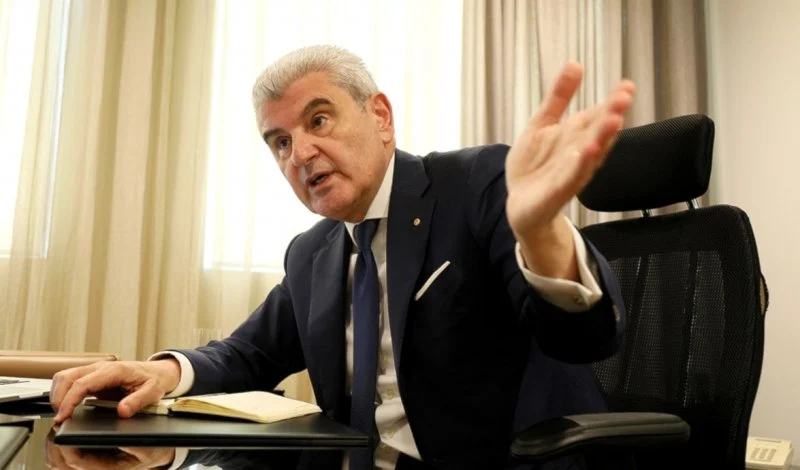
The Minister of Industry, Joe Issa Al-Khoury, explained during his participation in a meeting entitled “Lebanese Industry: For a Sustainable Future,” which was organized by the local network of the United Nations Global Compact, that the world is witnessing radical transformations in international trade. These transformations are not limited to the natural development of markets, but rather extend to a comprehensive restructuring, which does not take place through customs duties or quotas, but rather through new standards.
The minister indicated that Lebanon faces two options: either consider these changes as external pressures, or absorb them and turn them into a driving force for reform and growth. He stressed that global trade rules are changing, and that sustainability has become an essential part of it, and is not just an additional option, but rather a necessary condition for entering markets.
Al-Khoury also pointed out that carbon-related trade tools, circular economy requirements, packaging standards, due diligence obligations and traceability directly affect contract formulation, supply chains, financing decisions, and trade agreements. All of this requires reliable and verifiable evidence.
He considered that enhancing Lebanese exports in light of these developments constitutes a challenge and a strategic opportunity at the same time. He added that if sustainability becomes a non-tariff barrier, it must be dealt with efficiently and preparedly. If disclosure becomes the language of the market, it must be mastered. If verification becomes a standard of trust, systems must be built worthy of it.
Al-Khoury stressed that sustainability is no longer just an external requirement in the Ministry of Industry, but has become an essential part of the national industrial strategy. He added that Monitoring, Disclosure and Verification (MRV) systems are not just bureaucratic procedures, but rather are real industrial requirements that enable companies to measure emissions, trace materials, measure efficiency, and demonstrate compliance with standards, which reduces financing risks, opens doors to green financing, and protects exporters from sudden exclusion from markets.
He noted that evidence is now an economic asset, but sustainability must go beyond mere compliance to become a source of value creation. He explained that circular manufacturing reduces dependence on imports, that improving energy efficiency reduces production costs, and that packaging innovations enhance competitiveness, while transparency in disclosure enhances investor confidence.
Al-Khoury added that Lebanon, which relies heavily on importing energy and raw materials, benefits from every unit of waste avoided, from every increase in efficiency, and from every reliable sustainability report that facilitates access to markets. In this context, the Ministry is working to promote the concept of “Extended Producer Responsibility” (EPR) based on the “polluter pays” principle, as part of structural reforms, so that production is linked to measurable responsibility.
In conclusion, he stressed that these meetings should not be limited to mere side technical dialogues, but rather should turn into discussions about Lebanon’s position in future global value chains. He pointed out that the goal is not to resist global standards, but rather to benefit from them intelligently, through coordination between commercial and industrial policies, environmental regulations and financial frameworks, and building partnerships that enhance capabilities, to reach a competitive, reliable and future-ready Lebanese industrial sector. He stressed that sustainability is no longer an option that can be ignored, but rather has become part of the reality of global markets and their requirements, and that Lebanon is preparing to cross this stage with confidence and determination.