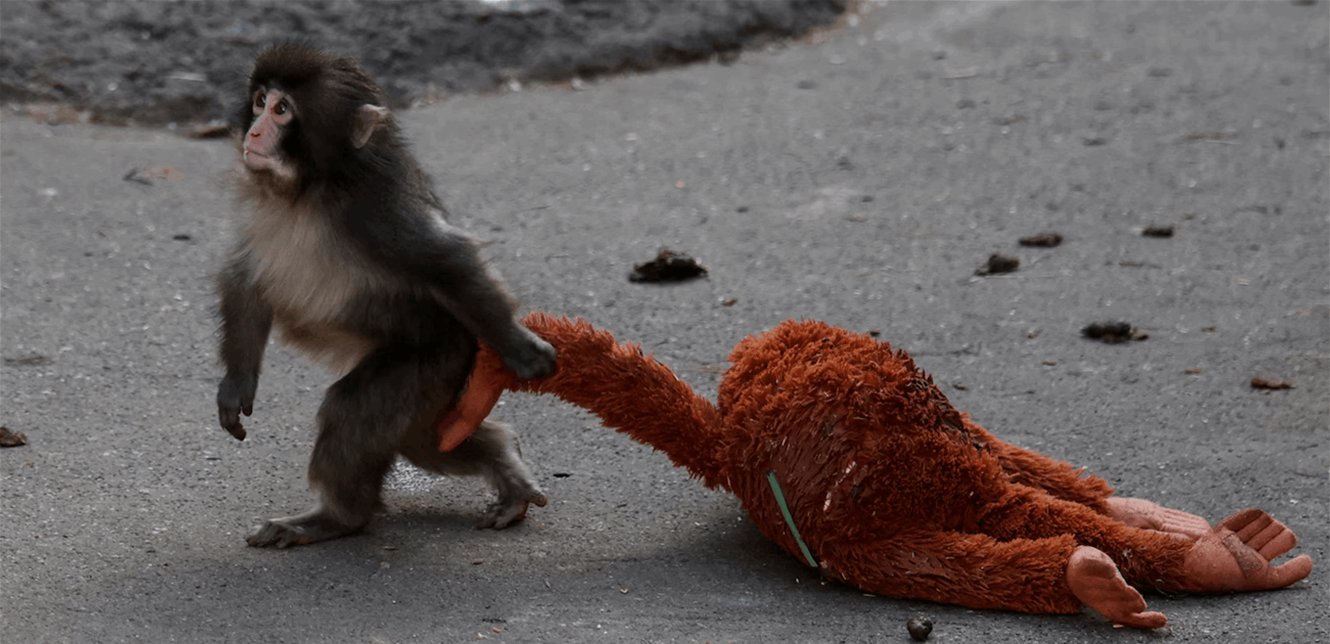
The seven-month-old macaque “Punch” is widely known internationally on social media platforms, but he faces difficulties in integrating with his peers at the Japanese Ichikawa Zoo, and suffers from loneliness. “Punch” grew up in the care of park employees after being abandoned immediately after his birth, who gave him a stuffed orangutan from IKEA as a substitute for his mother, who became his constant refuge and source of security.
“Punch” wanders around “Monkey Mountain” inside the park holding his doll, and is sometimes harassed and bullied by other monkeys, which prompts him to quickly return to his orangutan doll. Staff observed that shortly after a conflict, he would return to his toy for emotional support and then try again to reengage with the group, a “resilience and mental strength,” park management said.
The story of “Punch” sparked a wide wave of sympathy around the world, and led to a significant increase in sales of the IKEA doll (DJUNGELSKOG), which ran out of stores in Japan, the United States and South Korea, forcing the company to announce the imminent restocking of it. The zoo also saw a significant increase in the number of visitors.
From a scientific point of view, this story recalls experiments conducted by psychologist Harry Harlow in the 1950s, which demonstrated that providing comfort and affection is as essential to primate development as food. Experts confirm that Punch has a good chance of adapting socially if he is accepted by the monkey group, and are calling on the public to support him instead of showing pity for him or trying to interfere in his life.