“Lebanon Debate” – Walid Khoury
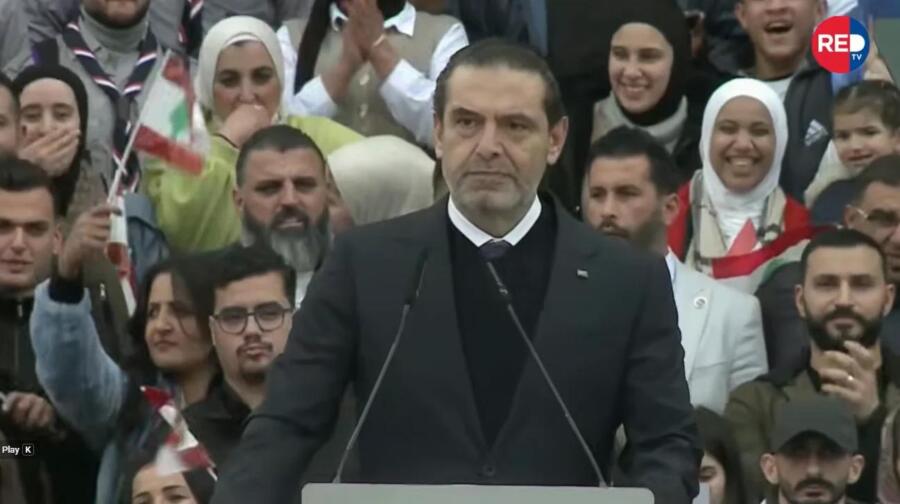
In words calculated by Al-Joharji’s balance, the speech of former Prime Minister Saad Hariri on the twenty-first anniversary of the martyrdom of Prime Minister Rafik Hariri was not merely a “speech of loyalty.” It was a full-fledged political positioning statement, reading the Lebanese moment in all its fragility, and reaffirming the man’s position within it, without declaring a clear “return,” and without burning the final decision card.
Hariri did not say, “I returned.” But he said what is more important: where he will return from, under what conditions, and under what ceiling. He did not specify a date, but he set a framework. He did not raise the ceiling, but he left enough signs to confirm that the door had been opened, and that the decision had become linked to merit, not mood, and to equation, not emotion.
In reading “Lebanon Debate,” the speech achieved 4 clear goals, carefully distributed between inside and outside, and between “neutralization,” “escalation,” and “conditional suspension.”
The first goal: to neutralize the Gulf clash and close the door to interpretation
The sentence that many took as constructive, was in fact the cornerstone: “Harirism was and will remain supportive of every Arab rapprochement and repels every disagreement, and whoever confuses the issue of Gulf and Arab disputes will have an empty basket and will burn his hands and his credit.”
Here, Hariri was not just addressing his audience. He was sending a political message to those trying to link his return to delicate Arab balances. He who lives in the Emirates realizes that any political step will immediately carry the meaning of alignment, or will be read as a position in a game of Saudi-Emirati differences. Therefore, he decided to “kill the novel” before it was born: no return in the face of Saudi Arabia, no return in the name of the Emirates, and no entry of Lebanon into the game of Gulf axes.
In this sense, he did not ask for cover from anyone, but rather prevented the use of his name and story in the polarization bazaar. He wanted the Arabic title to remain a title of rapprochement, not division. And that Harirism should remain outside of any clash.
The second goal: to establish popular legitimacy and confirm that the movement is not dead
Hariri knew that the opponents were betting on a long absence, and that some “alternatives” had risen on the wave of emptiness. Therefore, he emphasized the meaning that is not usually said directly: We have not left the equation, but rather moved away from it, but we have not lost the street.
When he says: “After 21 years, by God, you are not a few… You were never a few and you will never be anything but many,” he is not satisfied with raising morale, but rather re-establishing the “popular stock” as a solid base for any return. It conveys a clear political signal: any electoral entitlement without this weight remains politically and popularly incomplete.
Third goal: Redefining opponents under the title “daggers”
Here the tone rose. Here, Hariri moved from reassurance to internal conflict. He said it literally: “We have moved away, but we are present and we live your concerns and we see those who think they will cancel you and who have unfortunately turned themselves into daggers to stab me day and night.”
This statement is neither an emotion nor a political insult. It is a symbolic designation for the opponent. Whoever filled the void during the absence was not a “natural alternative,” but rather a party that invested in the absence to challenge and establish a new reality. With this description, Hariri re-sorts the scene: who is with him, who is against him, who stabbed him, and who traded in his name.
Most importantly, he linked this clash to the reasons for retreat itself, when he said that the retreat occurred when “what was required was for us to cover up failure and compromise on the state,” stressing that “politics at the expense of the country’s dignity and the state’s project has no meaning or place in our school.” That is, he re-presented retreat as a principled decision, not as a political inability, and placed his opponents in the category of those who benefited from an exceptional circumstance, not from a permanent transformation.
Fourth goal: Suspend return on the elections… and move the question from “he” to “she”
As for the bottom line, it was stated in the pivotal phrase: “Tell me when the elections are so that I can tell you what the future will do… I promise you that when they happen, they will hear our voices and count them.”
Here, the question is no longer: Will Hariri return? Rather: Will the elections actually be held? This is not a linguistic maneuver. It is a “conditional obligation” that links the decision to the maturity date, its context, and its guarantees. If the elections are held on time and with clear conditions, the transition to the decision to participate becomes natural. If the country enters into a scenario of postponement, disruption, or ambiguity, the decision remains suspended without political cost, because the man did not decide, but rather commented on a condition.
According to information from “Lebanon Debate,” Hariri deliberately kept the ceiling of his speech low and thoughtful. If he had been completely certain that the elections would take place on time, he would have raised the level of decisiveness and issued clearer signals towards a full return. However, the element of uncertainty, internally and regionally, forced the door to be opened without being crossed.
This drop in ceiling is not hesitation, but timing management. Keep a heavy sheet of paper and use it at a calculated moment. Testing the seriousness of the authority in respecting entitlement first, reading the direction of the regional winds second, and arranging the internal house third.
Scene summary
Hariri’s speech was not a promise of return as much as it was political engineering for this return: neutralizing the Gulf, fortifying the Arab position, internal escalation against the “daggers,” and keeping the final decision pending on one topic, which is the elections.
If elections happen, “they will hear our voices and count them.” If it does not happen, the decision remains in his hands. This is how Hariri wrote his message: The return is not an emotional moment… but rather a step on his terms, not on the terms of others.