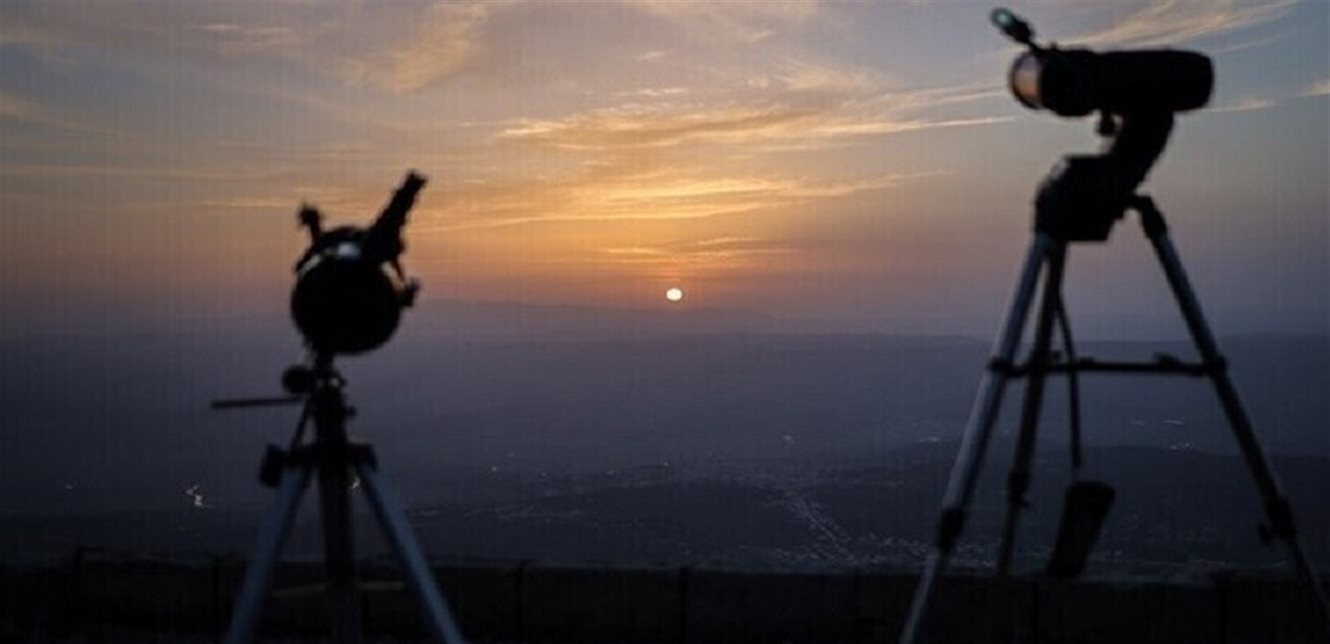
Millions of Muslims around the world are eagerly awaiting the moment the crescent of the holy month of Ramadan is sighted, marking the beginning of the month of fasting and worship.
This year coincides with a special astronomical event, as Tuesday, February 17, will witness the phenomenon of an annular solar eclipse, on the same day as the Ramadan crescent is sighted, in a rare scene that combines two events of religious and scientific importance. Will this eclipse affect the sighting of the Ramadan crescent?
Dr. Muhammad Gharib, a professor at the National Institute for Astronomical and Geophysical Research, confirmed in a special statement to Al Arabiya that the occurrence of an annular solar eclipse is considered an astronomical sign of the conjunction of the moon with the sun and the beginning of the lunar month from an astronomical perspective, but the Hijri month in Islamic law depends on the sighting of the crescent, and not on the phenomenon of the eclipse or conjunction only.
He stressed that the annular solar eclipse does not hinder the sighting of the crescent of the month of Ramadan in any way, and explained that the two phenomena are separate in terms of the practical impact on the monitoring process, and that the sighting of the crescent depends on other factors, such as the period of its stay after sunset, its height above the horizon, and the purity of the atmosphere.
He pointed out that the last annular eclipse was not visible in the Arab region at all, as its complete appearance was limited to Antarctica, while it was only partially visible in some regions of Argentina and Chile, and it did not have any visual impact in the Arab countries.
He explained that an annular eclipse occurs when the moon is between the sun and the Earth at the moment of conjunction, partially blocking the disk of the sun, due to the presence of the moon at a point relatively farther from the Earth, which makes its apparent size too small to completely cover the sun, so the sun appears in the form of a bright ring surrounding the black disk of the moon, hence the name “annular eclipse.”
He added that the duration of this type of eclipse is relatively short, and may reach about two minutes in some areas, as happened in the full range of vision in Antarctica, stressing that such phenomena are subject to precise astronomical calculations, and are not linked to any exceptional changes that affect the regularity of the lunar months or the crescent reconnaissance process.