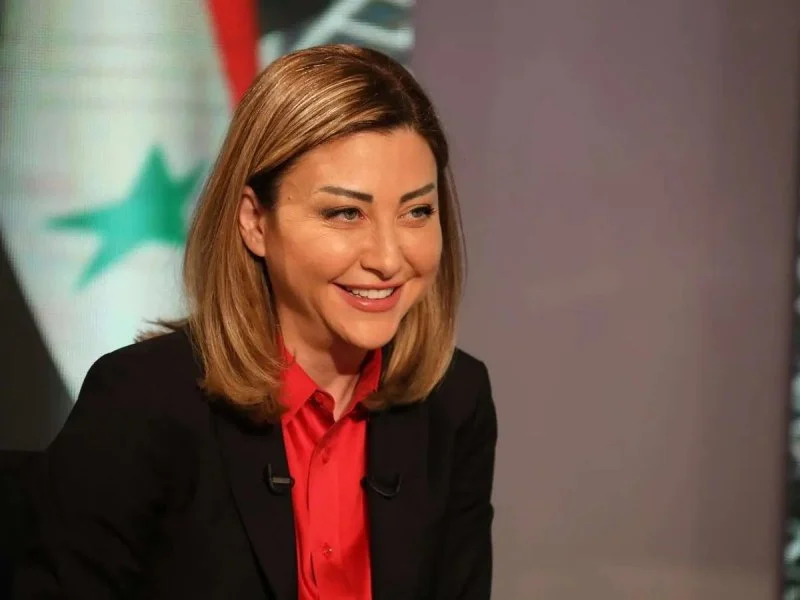
Luna Al-Shibl was not just a media advisor in the Syrian presidential palace. Rather, in the last years of Bashar al-Assad’s rule, she became one of the most controversial and influential figures in the inner circle surrounding him. Her rapid rise, then her mysterious death in July 2024, made her an intense symbol of the nature of governance in Damascus during that period: closed authority, complex personal relationships, and a lack of trust that reached the point of liquidation.
American writer Robert F. It was reported in a lengthy investigation published by The Atlantic magazine on February 6, 2026, that Al-Shibl, a former journalist for Al Jazeera, moved from the media to the heart of the palace, where her role was not limited to managing the image and discourse, but rather extended to include a direct influence on the political mood of the Syrian president, and his way of looking at home and abroad.
The article quotes former officials and sources close to the palace that Luna Al-Shibl became part of Assad’s inner circle, and enjoyed exceptional influence that made him depend on her in understanding the media and political scene, and in settling scores within the circle around him. They point out that it encouraged him to underestimate the Syrian street and the increasing social pressures, and contributed to deepening his separation from the reality of a country that was suffering from an economic and living collapse.
One striking scene, as reported in The Atlantic, was an audio recording that circulated in late 2024, in which Al-Assad and Luna Al-Shibl were heard mocking Hezbollah members and the soldiers saluting them as they passed through a Damascus neighborhood. In the recording, Al-Assad comments contemptuously about the Syrians, saying that they “spend on mosques and have nothing to eat,” in a scene that was considered a blatant embodiment of the leadership’s disconnection from the suffering of the people.
Other accounts, cited by the investigation from multiple sources, indicate that Al-Shibl’s influence was not only political and media, but also personal. It is alleged that she played a role in providing women to Assad, including the wives of senior officers, which made her an undesirable person within the regime’s apparatus, and a source of hostility in an environment that cannot tolerate this kind of overlap between private and public matters.
On the other hand, more sensitive accusations appear. According to what Worth reported from a former Israeli security official and sources close to the regime, Luna Al-Shibl is suspected of later becoming a secret communication channel with Moscow, and providing information to the Russians about the nature of the Iranian presence in Syria and its activities. According to this account, Al-Shibl, realizing Assad’s weak position and approaching end, may have sought to secure an “alternative umbrella” for herself outside the palace, leaving her vulnerable to fatal suspicions.
In July 2024, Luna Al-Shibal was found dead inside her BMW on a highway near Damascus. The regime’s media announced that the death was the result of a traffic accident, but the circumstances of the accident raised widespread questions. According to circulating reports, the car was not significantly damaged, while tests showed that the head injury was fatal, which raised hypothesis of liquidation.
Stories varied about who was behind her killing. Some leaks spoke of an Iranian-ordered liquidation, due to suspicion of leaking information to Israel, in light of the escalation of tension within the “axis of resistance.” However, another account, reported by The Atlantic from informed sources, indicates that Assad himself was the one who ordered her killing, after he began to doubt her loyalty and her movements, in a scene that reflects the climate of suspicion and isolation that prevailed in the palace in its final months.
The investigation concludes that the Luna Chebl case is not just an isolated incident, but rather reflects a breakdown in trust within the governance structure itself. The presidential palace, which had always seemed like a closed fortress, was transformed into an arena of silent conflicts, where proximity to the president became as much a danger as a privilege. With the fall of the regime a few months after her murder, Al-Shibl appeared to be one of the first victims of the period of internal disintegration that preceded the major collapse.