Call of the homeland
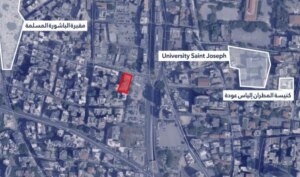
Some residents of southern border villages, specifically the Aitaroun Triangle, Bint Jbeil, and Maroun al-Ras, narrate that during the violent battles with the Israeli army in July 2006, some houses were painted with special paint that made it easier for aircraft to determine the locations of Hezbollah members. The paint was used by Israeli agents and spies to identify targets and bomb them.
According to the residents, Hezbollah discovered the identity of some of the agents, so its youth arrested them on suspicion of them, before one of the buildings was painted and was later targeted by an Israeli raid that led to their immediate death.
This story, which was confirmed by more than one source, intersects with what Hezbollah is doing today in terms of secret trials and investigations with those suspected of working for Israel, playing the role of the state and the security services. According to a military source, “What is different today in particular is the scale of the security breach, which exceeded Hezbollah’s expectations. In 2006, the networks of agents and spies were limited and much smaller. Between 2008 and 2009, the Lebanese security services arrested a number of agents and eavesdropping devices and computers were confiscated from their homes.” The source continues: “There was coordination and the number of agents was limited, but today the number of agents arrested by the state, and the regular positions and positions they hold in the “party,” is not proportional to the size of the breach within the “party,” which must have been at a high level and not at the level of small elements, as everything that happened (assassinations of leaders, focused attacks) could not have happened without a large and effective human breach.”
This intersects with information published by “Nidaa al-Watan” about the “party” carrying out trials, secret investigations, and field executions, out of sight, in southern regions in order to preserve its image, presenting some of them as “martyrs” and mourning them, preventing any criticism or protest. According to sources close to Hezbollah, “Iran intervened in the recent investigations and sent officials from the Iranian Revolutionary Guard to supervise the investigations to find out the whereabouts of the security and human breaches in the party.” The sources add: “In all of these investigations, the leadership is keen to keep them extremely secret, even for narrow circles, and if they are asked, they may say that there was a breach but we do not know the reason for it, which indicates the seriousness of what these investigations revealed regarding the extent of the breach within the party.”
According to some intelligence sources, these investigations are not limited to Lebanon alone, as they revealed that “some of the threads of human breach began in Tehran, which led to the facilitation of major assassinations in Lebanon and outside it, that is, targeting leaders of the Hamas movement. In light of this scale of breach, secrecy was necessary in the investigations and in the implementation of judgements.”
According to the information, these investigations indicated “a breach in the party’s internal ranks at high levels, due to the Syrian and Yemeni wars, and the exposure of a large number of members and leaders to Israeli technological development, in light of internal competition in the party to obtain positions and gains. Together, these circumstances made it difficult to control matters in depth, even though the party appeared on the surface to be cohesive and strong. Secret investigations with the suspects and agents revealed the fragility of the party,” according to the sources.
Field executions
Political writer Ali Al-Amin says: “Hezbollah carried out sentences against agents or suspects, including death sentences. The party certainly did not hand over any of its members to the Lebanese judiciary and did not announce its rulings in this regard. It allows the sentences to be implemented away from advertising and the media and in a very secret manner. The agent made the enemy a ‘happy martyr’ on the road to Jerusalem or a ‘martyr’ of sacred duty.”
Al-Amin said in an interview with “Nidaa Al-Watan” that “it is difficult to estimate the number of those who were subjected to these trials within the party, because these trials, their results and their rulings remain secret, and their secrecy is the basis of their existence, to protect the purity and sanctity of the party in front of its audience in the first place, as this party is not one that can include an agent of the enemy according to the narrative that is being promoted.”
He added: “Many agents were mourned after their execution as martyrs who fell in honorable confrontations. This is confirmed by sources from within the party in an undeclared manner. It is also sufficient to say that Hezbollah, since its founding until today, has not announced any agent of Israel within it, and has not issued and consequently implemented any ruling by its party court.”
Al-Amin believes that “Hezbollah is a security apparatus before anything else. The security mentality is what directs it and formulates its decisions, and therefore, it deals with the issue of the Israeli violation of its organizational body, with a security mentality that hides all enemy labor files, in private and closed circles, far from any civil disputes that might push the client’s family to protest and doubt, on the one hand, and preventing the exposure of these files before the courts of the Lebanese state on the other hand.”