Paula Astih – Middle East
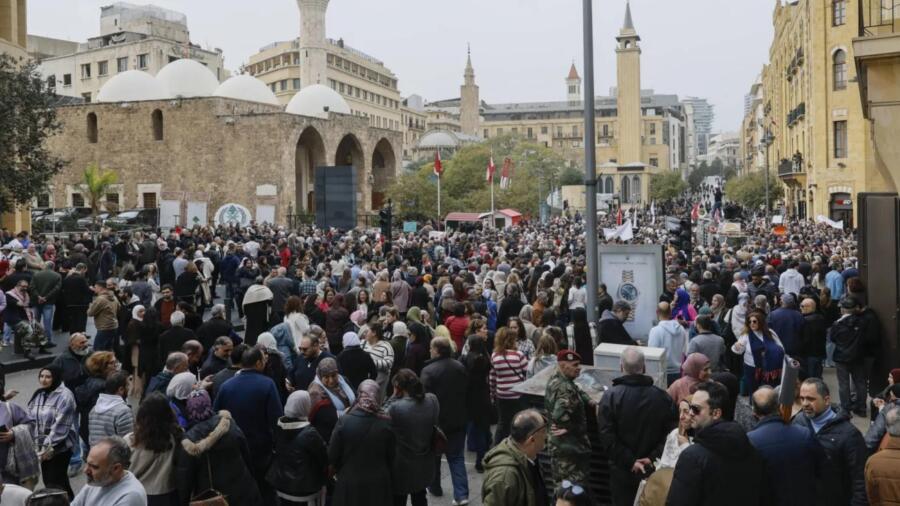
Demand movements suddenly exploded in the face of the government a year after its formation, with what appeared to be an announcement of the end of the grace period given to it to address financial and economic conditions more than 6 years after the outbreak of the crisis in the fall of 2019, the explosion of protests, and the beginning of the monetary and banking collapse.
The 2026 budget discussion sessions in the Parliament last week formed a gateway to the launch of demands and protests in the street, issued by retired military personnel, contract professors, and workers in the public sector. The administrative body of the Public Administration Employees Association announced, in a statement, the escalation and expansion of the strike in all departments this week, starting Monday.
Public sector demands
Public sector workers are demanding the issuance of a new series of ranks and salaries after the significant decline in the purchasing value of their salaries, noting that the last series was approved in 2017, and was a contributing factor among a group of other reasons for the financial collapse, as salaries were increased and some of them were doubled at that time without accompanying structural reforms (controlling employment, reforming administration, and combating waste), and their funding sources were partial and unsustainable.
The government currently refuses to approve any new series for fear of repeating the 2019 collapse scenario, and it is currently considering limited salary increases to reach 50 percent of what it was before the crisis.
The problem with the “salary basis”
“The basis of the salary for public sector employees is still the same as it was before the crisis (on the basis that one dollar is equal to 1,500 Lebanese pounds, and today it is equal to 89,000 pounds), since after the financial collapse the state began granting social grants and aid, reaching a limit of 13 salaries, in addition to a productivity allowance and a transportation allowance, and thus those whose salary was one million pounds (about 700 dollars before the crisis) have now reached 40 million liras ($447).”
Shams El-Din pointed out, in a statement to Asharq Al-Awsat, that “the main problem is that the continuation of the salary basis as it is is reflected in the end-of-service compensation.”
He added: “Before the crisis, the cost of salaries was 6 billion dollars, but today this cost amounts to 2 billion and 700 million dollars, which means that most employees in the public sector are currently receiving half of what they were earning before the crisis,” noting that “the salaries of representatives and ministers are currently about 3 thousand dollars, while the salary of the President of the Republic is about 3,500 dollars.”
Military status
Retired soldiers have been at the forefront of demand movements in the recent period, expressing not only their dissatisfaction with the outcome of their situation, but also the suffering of soldiers in active service who are unable to object and demonstrate, as the salaries of military personnel, whether in service or after retirement, range between $300 and $1,000 for officers.
Retired Brigadier General George Nader deplores the fact that some people considered that increasing military salaries might lead to a new financial collapse, as happened after the series of ranks and salaries that were approved in 2017, considering that this series “was an electoral bribe, and was prepared randomly, and it was the lowest increases at the time for the military. The law that was passed included a ban on employment for five years, but in the same year more than 5,000 people were employed.”
Nader stressed in a statement to Asharq Al-Awsat that “it is not increasing the salary of the employee who performs his duties with dedication and sincerity that leads to the collapse of the state’s finances, but rather increasing the salary of the employee who is not working, and thus confronting the financial collapse must first be done by purging the administration by terminating the work of employees who do not perform their jobs and who take bribes,” explaining that the military currently receives 23 percent of the value of their salaries before the crisis, “so today we are demanding increases so that our salaries reach at least 50 percent of what it was before 2019, with an increase of 10 percent every 6 months, in order to return to its previous state successively.”
Professors and the public sector
The situation of contract professors in the public sector is not better, as they currently receive $8.2 per hour, after they were paid $13 before the crisis. They are surprised at how the improvements included exclusively the salaries of public school teachers (known as staff teachers), whose percentage does not exceed 20 percent, and their salaries now range between 950 and 1,000 US dollars.
Dr. Nisreen Shaheen, President of the Association of Contracted Teachers in Public Basic Education in Lebanon, explains that 80 percent of the teaching staff in public schools are contractors, stressing in a statement to Asharq Al-Awsat that the basic demand they are raising today “which constitutes a radical solution to the problem, is confirmation and transfer to staff. We also demand that the transportation allowance we receive be modified, which is limited to three days, instead of it being for each day of work, in addition to increasing the hourly allowance to become $13 as it was before the crisis.
Is a salary increase possible?
University professor Maroun Khater, a writer and researcher in financial and economic affairs, considers that “the uprising of public sector employees is not a circumstantial event or just a struggle over wages. Rather, it constitutes a dangerous indicator of a deep economic and financial blockage, and of a state unable to transform the long collapse into a viable reform path due to the blockage of the political horizon caused by the recklessness of some.”
Regarding whether the state is able to bear a salary increase that may reach 50 percent of its current level or more, Khater said in a statement to Asharq Al-Awsat that “the margin of movement seems very narrow.” The general budget is modest in size, empty in content, and devoid of vision. It depends approximately 83 percent on tax revenues, and is almost devoid of reform and investment spending. Therefore, in light of a stagnant economy, almost non-existent growth, an almost complete absence of investments, and a shrinking and unfair tax base, any ill-conceived increase in wages, no matter how socially just, will be financed through additional taxes or indirect fees, which will lead to a rapid erosion of the value of these increases due to inflation, and to placing the same burden on the category of citizens who are already obligated to pay taxes.
He adds: “As for talking about approving a series of new ranks and salaries, it brings to mind the experience of 2017, when a series was approved in light of fragile financial and monetary stability, and it was one of the factors in deepening the imbalances that exploded later. Today, in light of more fragile conditions, repeating the experience without sustainable financing based on actual economic growth may lead to a more severe financial collapse.”
Khater explains that “any sustainable solution cannot be limited to random increases, but rather must start from a comprehensive restructuring of a public sector that is bloated, weak in productivity, suffering from rampant corruption, and subject to political and sectarian clientelism.”