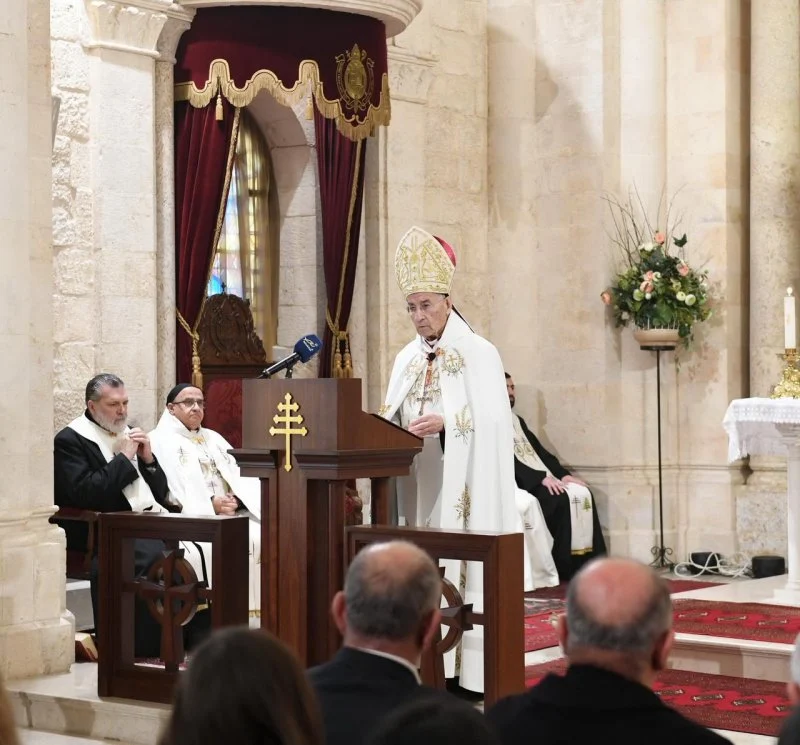
In his sermon on the occasion of the Sunday of the Righteous and the Righteous, which he delivered in Bkerke on February 1, 2026, Maronite Patriarch Cardinal Mar Bechara Boutros Al-Rai stressed the social importance of preaching the Gospel, based on the words of Jesus Christ: “I was hungry and you fed me” (Matthew 25:35). He considered that this aspect is based on the comprehensive development of the human being, and his liberation from all obstacles that hinder his human, cultural, economic and moral progress.
Al-Rahi delved into the meanings of the six needs, explaining that hunger is not limited to the need for food, but rather extends to include the need for knowledge and spirituality. He added that thirst goes beyond just the desire for water, to include a longing for justice, passion and knowledge. He explained that nudity is not limited to losing clothes, but rather includes attacks on dignity and justice. He pointed out that illness may be physical, psychological, or moral, that estrangement may be inside or outside the homeland, and that imprisonment is not limited to physical restrictions, but rather includes enslavement to whims or wrong ideas.
He stressed that these cases affect individuals and societies, and require a process of liberation, considering that preaching the Gospel is a call to liberate man, just as Christ liberated him with his words, miracles, death, and resurrection.
He pointed out that this Sunday’s Gospel condemns any regime that does not put people at the heart of its interests, any policy built at the expense of the weak, and any official who treats power as a privilege and not as a service. He stressed that the righteous are not the holders of positions, but the holders of consciences, and that nations are not established by force, but by love, nor by corruption, but by honesty and shared responsibility.
Al-Rai explained that Lebanon today needs a revolution of conscience and not just a change in faces, calling for the presence of honest people in politics, righteous people in economics, honest people in administration, and compassionate people in society. He stressed that the renaissance begins when the hungry becomes a priority and not a burden, and the person becomes a goal and not a means.
In another context, Patriarch Al-Rahi stated that the Executive Council of the Ogero Union visited him two days ago, where it presented him with a set of legitimate demands related to the conditions of workers in the sector.
He explained that the first demand is to amend Article 49 of Law No. 431 issued in 2002, noting that the passage of more than twenty years since the passage of this law has put employees in a difficult position, especially with regard to Article 49 of the Telecommunications Sector Regulatory Law, which has become a continuing injustice against them, due to its conflict with the current economic situation and the laws that were issued later.
He added that the second demand relates to the impact of privatization and the necessity of protecting the compensation fund stipulated in Law No. 161, as the union delegation emphasized the rights of employees and the essential role played by this fund, from which public institutions benefit under the aforementioned law. In this context, Al-Rahi appealed to officials to work to protect the Compensation Fund from any decisions that might affect its continuity.
The third demand is to provide justice to the day laborers, by finding an immediate legal solution that leads to their integration and ensuring their job and social stability.
Al-Rahi concluded the sermon by praying for Lebanon, calling for the birth of a generation of righteous and honest people who build the nation with love, not interests.