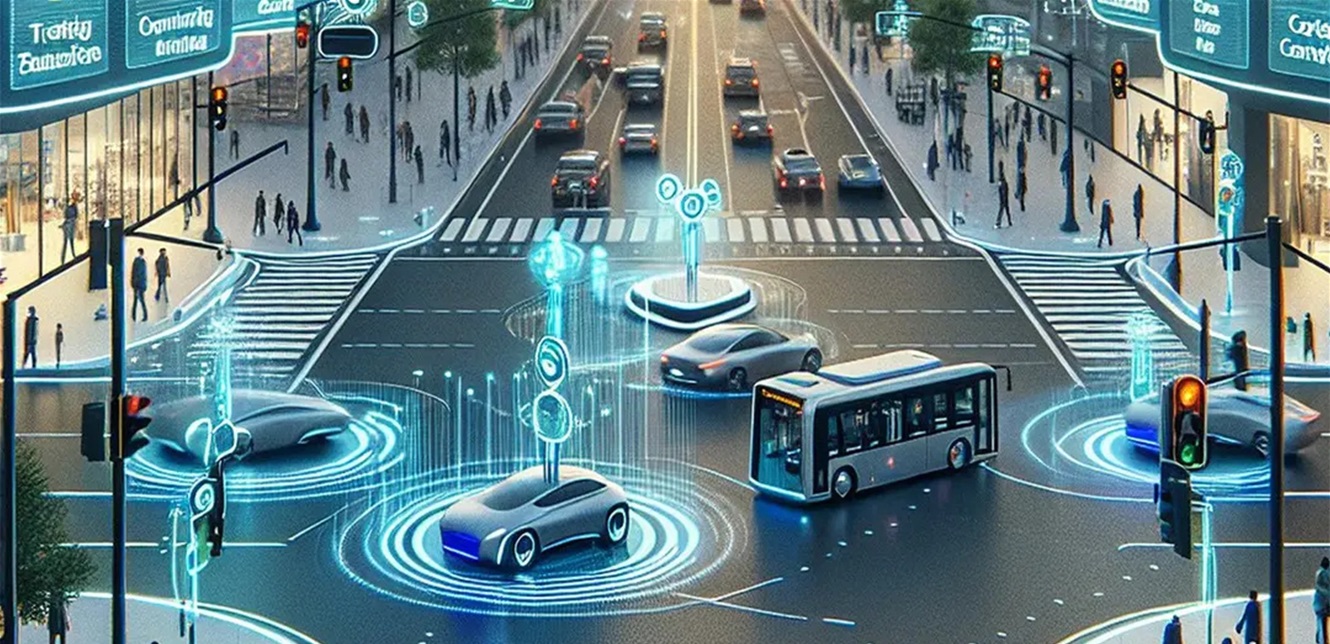
A team of Japanese researchers has discovered an innovative method for operating artificial intelligence (AI) by harnessing real traffic flow as an alternative to traditional computing systems, significantly contributing to energy conservation.
The scientists have named this technology “Harvested Reservoir Computing (HRC),” and it was developed at the WPI Advanced Institute for Materials Research at Tohoku University in Miyagi Prefecture, Japan.
This system is based on leveraging the natural dynamics inherent in complex systems, such as urban road networks, instead of relying entirely on traditional processors that consume significant amounts of energy. This AI framework treats traffic as a computational resource, capitalizing on the behaviors of complex systems in data processing.
To implement this idea, the team created a model called “Road Traffic Reservoir Computing (RTRC),” which relies on using traffic flow on road networks as a computational reservoir. The system processes data through the constantly changing interactions between vehicles, through a combination of laboratory experiments using 1/27th scale self-driving miniature cars and digital simulation of urban road networks.
The researchers discovered that the system’s predictive accuracy peaks at a medium density level before congestion occurs, where traffic dynamics are at their most diverse and useful, in contrast to free-flowing or fully congested conditions. This method allows for highly accurate prediction of future traffic flow while minimizing the computational load, without the need for new specialized hardware, relying on currently available traffic sensors and monitoring data.
The team believes that roads and other social infrastructure can be re-envisioned as massive, continuously operating computers, which could change the way smart cities manage traffic, energy, and urban planning, and reduce overall energy demand.
Professor Hiroyasu Ando, head of the research team, stated: “The results show that computing does not have to be limited to silicon chips. By recognizing and exploiting the rich dynamics present in our environment, we can build robust and sustainable AI systems.”
The researchers added that this concept may pave the way for the development of new core technologies for AI, by integrating physical systems and data in innovative ways, instead of continuously increasing the size of computing devices.