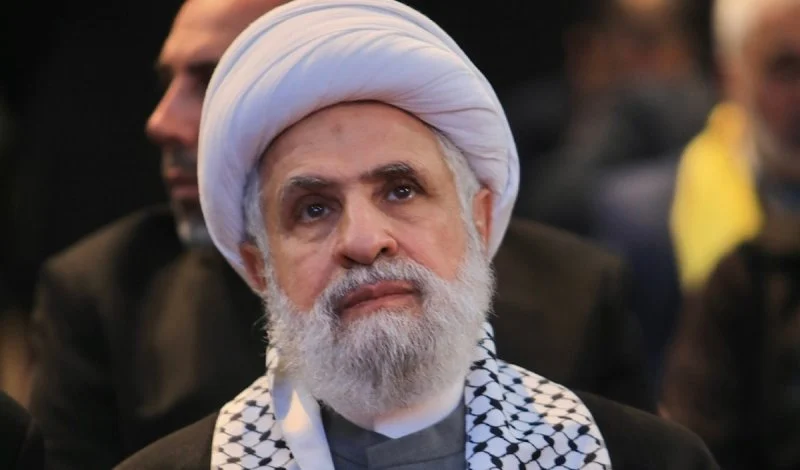
Observers believe that the Secretary-General of “Hezbollah,” Sheikh Naim Qassem, is making a mistake when he thinks that his frequent appearances on television screens before his audience will enhance his popular base and consolidate their support for retaining weapons, especially without providing clear commitments to rebuild the destroyed villages in southern Lebanon. Weapons, in their view, are no longer a force, and will not change the political reality that forces the party to engage in the state project and comply with the principle of restricting weapons to the state.
In this context, journalist Muhammad Shuqair mentioned in an article in the newspaper “Al-Sharq Al-Awsat” that observers “indicate that Qassem raised his political ceilings using expressions that do not conform to the political lexicon, which he could have dispensed with, especially since those who make these observations are not classified as his opponents. Adopting a language closer to threat, with the aim of reducing the pressure calling for disarmament, does not provide reassurance to his environment, which is waiting for guarantees to rebuild its destroyed towns, and for the party to continue to meet its needs until the start of the reconstruction workshop, especially for tens of thousands of displaced families from the border villages that have turned into isolated areas by fire.”
These observers confirm that Qassem knows very well that reconstruction will only be achieved by restricting weapons to the state, by agreeing to the plan developed by the Lebanese army command and adopted by the government for implementation in stages, with the readiness to move to the second stage that extends from north of the Litani River to the Awali River.
Others also believe that Qassem did not need to respond to the President of the Republic, General Joseph Aoun, in his strong criticism of Foreign Minister Youssef Rajji, but rather he should have prepared the atmosphere for the success of the ongoing dialogue, which is led by the head of the “Loyalty to the Resistance” bloc, MP Muhammad Raad. A ministerial source indicates to “Al-Sharq Al-Awsat” that this dialogue is currently going through a period of suspension of direct communication, and is replaced by meetings undertaken by the presidential advisor, retired Brigadier General Andre Rahal, sometimes with Raad, and mostly with the team in charge of the dialogue file.
The ministerial source believes that there is no need to raise the ceiling of demands under the pretext of confronting the political attack on the party because of its retention of weapons, while it participates in the government on the basis of its support for the ministerial statement, which stipulates the state’s monopoly on weapons. The source wonders whether the choice of this timing is linked to the escalating American pressure on Iran, in an attempt to send a message that targeting the head of the axis of resistance does not justify bullying the party.
The source points out that Qassem’s recent speech seemed like a direct response to the President of the Republic, and therefore to the Prime Minister, Nawaf Salam, who is seen as the most stringent in his demand to hand over weapons. He also wonders about Qassem’s disregard for the Arab and international meetings that brought the three presidents together, and about the message he will send to his audience in light of the international community linking aid for the reconstruction of the south to its agreement to restrict weapons to the state.
The source adds that the party leadership realizes that its weapons no longer have a role in liberating the south after the exhaustion of their military purposes, and that the diplomatic option alone opens the door to negotiation to obligate Israel, under American pressure, to reach an agreement to cease hostilities.
The source confirms that there is nothing preventing Qassem from supporting the Speaker of Parliament, Nabih Berri, politically, who is asking the United States to pressure Israel to implement its obligations, within the framework of the concomitance of steps, with his continuous criticism of the “Mechanism” committee supervising the implementation of the agreement, without opposing the exclusivity of weapons, but rather supports the oath speech and the ministerial statement.
The source warns against a wrong bet by the party on replacing weapons with a political price, considering that this price will only be granted to the state to enable it to extend its control over all of its territory in implementation of Resolution 1701, and to secure the necessary aid to get Lebanon out of its economic and financial crisis.
The source also records observations on Qassem’s position on Resolution 1701, wondering how it will be implemented and the fate of the disputed border points, the file of border demarcation according to the 1949 Armistice Agreement, and the impact of that on the issue of the Shebaa Farms.
In the same context, a parliamentary source supporting the restriction of weapons wonders whether the other partner in the “Shiite duo,” namely the “Amal” movement, shares Qassem’s raising of the ceiling of demands, or whether he is playing solo in the absence of any similar position from the “Development and Liberation” bloc. He points out that the “duo” coexist under one roof with different views on the southern file, with their agreement on demanding that the United States obligate Israel to implement what it has to do in the agreement to cease hostilities.
The source concludes by pointing to a difference in the way of dealing with the President of the Republic, where Berri affirms the strength of his relationship with Aoun, while the party chose to respond to his position on weapons. However, Berri is keen to embrace the party and absorb it to prevent crossing the red lines, despite the waving by his circles of the possibility of political escalation, while ruling out going beyond that.