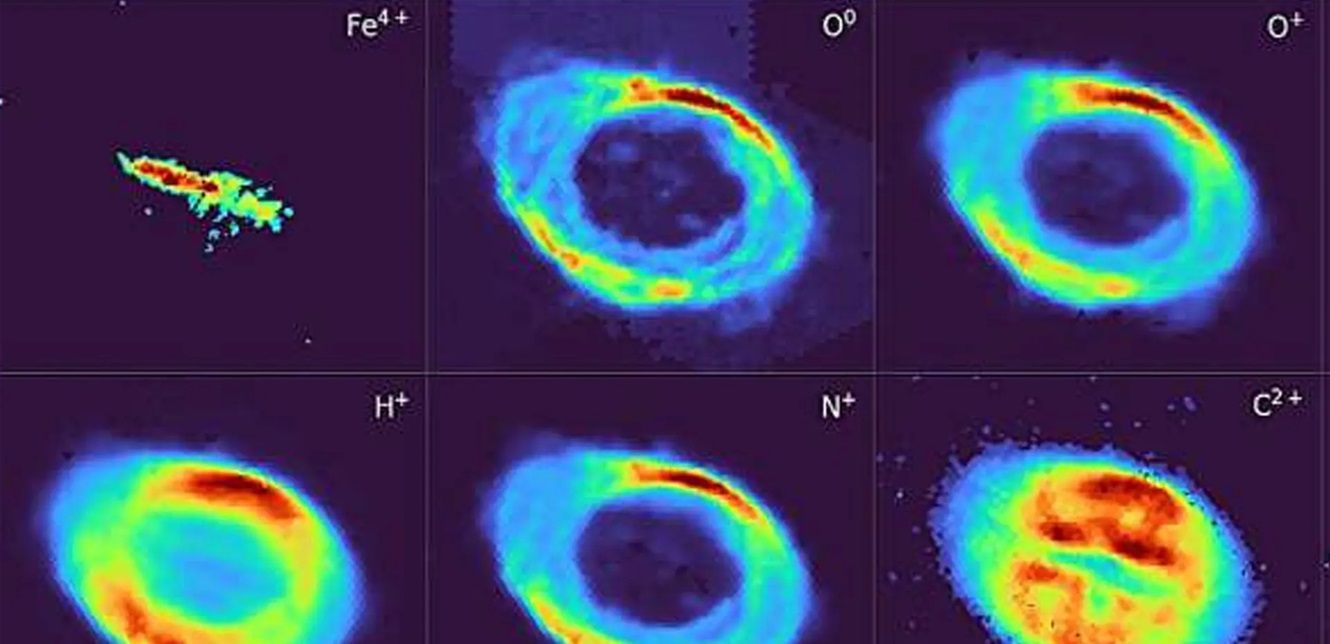
An international team of astronomers has revealed a stunning discovery in the heart of a famous “Ring Nebula,” where they spotted a massive, narrow band composed almost entirely of iron atoms. This band stretches for an estimated “500 times the orbit of Pluto” and contains an amount of iron equivalent to the mass of Mars, raising new questions about how stars die, how nebulae form, and the fate of planets near dying stars.
Researchers confirmed that the cause of this band’s formation remains a perplexing mystery. They stated, “So far, there are no clear explanations that explain the existence of this narrow band.” This discovery illustrates that even celestial bodies that appear familiar conceal new secrets within them.
This discovery was made possible thanks to the modern “WEAVE” instrument installed on the “William Herschel Telescope” in Spain. This instrument allows light to be collected from all parts of the nebula simultaneously and analyzed across all light wavelengths. In this way, the team was able to determine the chemical composition of each point in the nebula with high precision.
Images and analyses revealed a bright, narrow band in the center of the nebula, emitting ionized iron light. This band is located within the inner oval ring of the nebula and does not appear in other wavelengths. According to researchers, the amount of iron in this band is approximately equal to the mass of Mars, making it difficult to explain based on current models of planetary nebula formation.
Researchers offer several possible explanations for this phenomenon, including that the band may represent an unknown stage of stars ejecting their outer layers, or that it may be the remains of a rocky planet that approached the star too closely and evaporated into an arc of hot plasma. However, further studies are still needed to determine if there are other elements mixed with the iron.
Scientists plan to observe the nebula again using “WEAVE” with higher spectral resolution. They will also conduct a survey of many other ionized nebulae in the Milky Way galaxy over the next five years, and these studies may reveal that the Ring Nebula is not a unique case.
Scott Trager, a researcher from the University of Groningen, said: “The discovery of this mysterious structure in the jewel of the night sky demonstrates the amazing capabilities of the WEAVE instrument, and we look forward to many other discoveries using it.”