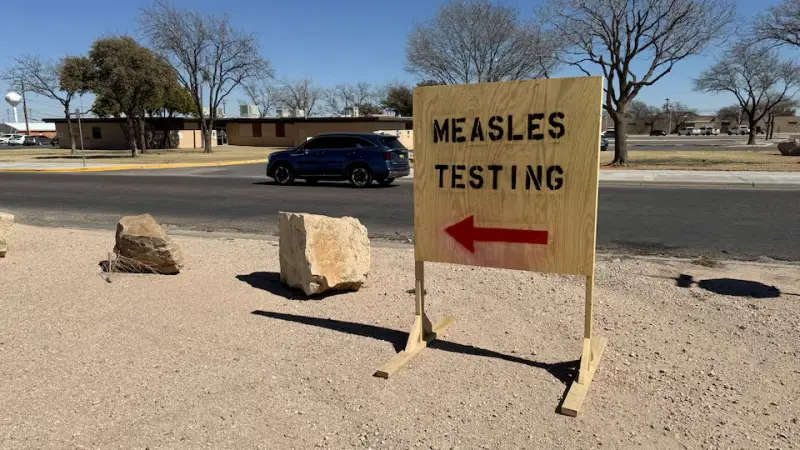
Health officials are struggling to contain two growing measles outbreaks in the United States, as new cases continue to rise weeks after holiday travel and gatherings contributed to the virus’s spread.
In South Carolina, officials confirmed 124 new measles cases, bringing the state’s total to 434.
The outbreak is centered in Spartanburg County and has become one of the largest in the country.
Meanwhile, health officials reported that a separate outbreak along the Arizona-Utah border has infected 418 people since August.
The cases are concentrated in border communities near Hildale, Utah, and Colorado City, Arizona, an area known as “Short Creek.”
Last year marked the worst year for measles spread in the United States since 1991, according to the Centers for Disease Control and Prevention (“CDC”).
In 2025, 2,242 measles cases were reported in 45 states. Three people died, all of whom were unvaccinated.
Measles:
Measles is a highly contagious virus that spreads through the air when an infected person breathes, coughs, or sneezes. Symptoms usually begin with fever, cough, runny nose, red and watery eyes, followed by a rash.
While many children recover, measles can cause serious complications, including pneumonia, brain swelling, blindness, and death.
The CDC considers measles to have been eliminated in the United States since 2000, but ongoing outbreaks threaten this status.
Measles in Carolina:
The South Carolina outbreak has spread rapidly over the past month. Hundreds of children have been quarantined after being exposed to the infection in schools, some more than once.
Officials also confirmed that someone with measles infected others at the “South Carolina State Museum” in Columbia last week.
The South Carolina outbreak may soon approach the levels of the Texas outbreak last year, where 762 cases and two child deaths were reported. Health experts suspect the number may be undercounted.
In the Western United States, health officials in Arizona reported nine new cases on Tuesday, bringing the total in Mohave County to 217. Utah also recorded two additional cases, bringing the total to 201.
Officials in both states say the true number of infections may be higher.
Health officials emphasize that the measles, mumps, and rubella (“MMR”) vaccine remains the best way to prevent infection. Children are advised to receive the first dose between 12 and 15 months of age, and the second dose between 4 and 6 years of age.
After two doses, the vaccine is 97% effective and provides long-lasting protection.
Measles spreads more easily when community vaccination rates fall below 95%, the rate needed to achieve herd immunity.