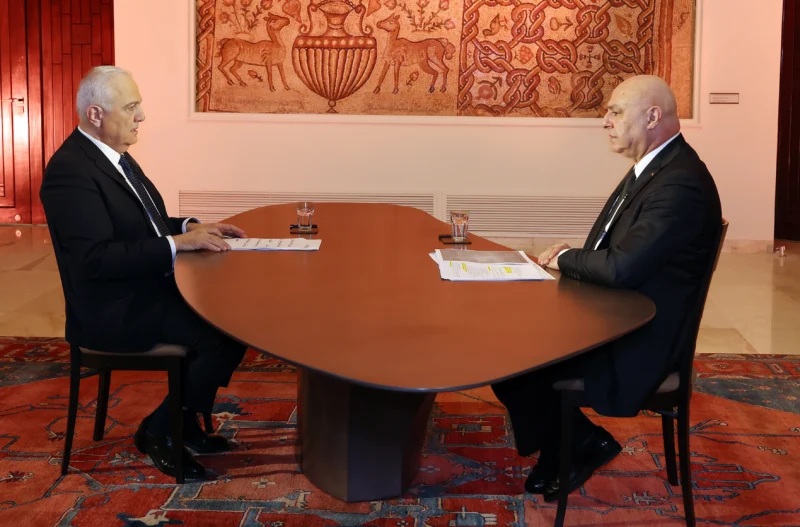
In a televised interview marking one year since assuming office, the President of the Republic, General Joseph Aoun, stated that the inaugural address is “not ink on paper,” and that he will strive “the impossible” to implement its provisions. He affirmed that the President is a “referee, not a party,” and that the powers are not limited to the texts, but are exercised to serve the people and institutions.
Aoun clarified that the decision on the exclusivity of weapons and the decision on peace and war are “internal decisions” taken by the Council of Ministers, and not external impositions. He pointed out that the role of weapons outside the authority of the state has “ceased” with the presence of the army, and has become a “burden” on its environment and on Lebanon, and no longer has a deterrent role. He added that the army has achieved “operational control” south of the Litani, which means the ability to prevent any military operations and intervene to thwart them, while acknowledging the possibility of finding warehouses or tunnels due to the rugged nature of the area, but the most important thing is to prevent the south from becoming a launching point for any military action.
In the same context, Aoun affirmed that Lebanon is “tired” of the policy of axes and refuses to be a platform that threatens the stability of any country. He revealed that after the launch of missiles in the summer, some of which fell inside Lebanon, the Directorate of Intelligence was able within a week to arrest the cell that launched them, and Hamas officials were informed that if the matter was repeated, “they would be deported from Lebanon,” stressing that Lebanon will not allow any party to take it to “a place it does not want.”
The President of the Republic denied the rumors about the presence of senior officers from the Assad regime in Lebanon, considering it incorrect based on the data, security reports, investigations, and raids carried out by the Directorate of Intelligence in various regions. He explained that those present are refugees and some elements and officers of small ranks who have no influence.
Regarding the negotiation process, Aoun said that Lebanon “has taken a decision to negotiate,” which is a sovereign decision not imposed by any party. He considered that diplomacy, economics, and war are tools of politics, and that the experience of war was costly. He added: If we do nothing, the chances of progress are “0%,” and if we take the diplomatic path, there is “50%” for progress, so why not try it? He revealed that the specter of a major war and ground invasion is now much more distant, despite the continuing attacks, noting that there is an internal party that does not want to remove the specter of war.
Regarding peace, Aoun clarified that peace is a “state of non-war,” recalling the 1949 armistice agreement. He added that the current efforts fall within the framework of security measures or an agreement that includes withdrawal, cessation of attacks, restoration of prisoners, and resolution of the border problem, which is a fundamental step towards peace. He affirmed that Lebanon is for peace that achieves justice and does not fear it, and that the political reference remains the Arab Peace Initiative emanating from the Beirut Summit.
In the file of prisoners, the President of the Republic affirmed that he does not forget the Lebanese prisoners and demands their release in all his positions at home and abroad. He revealed that he raised the issue with the President of the International Committee of the Red Cross at the United Nations and then at Baabda Palace, and she informed him that Israel refuses the entry of a delegation from the Red Cross to meet the prisoners or see their conditions or even know their locations and health status, stressing that the file will be on the negotiation agenda.
Aoun touched on the appointment of former Ambassador Simon Karam to the “Mechanism” committee, explaining that one day before the arrival of His Holiness the Pope to Lebanon, he received a message from the American side stating that Israel had agreed to participate in the “Mechanism” meeting with a civilian diplomat. After the end of the visit, he met with Presidents Nabih Berri and Nawaf Salam and informed them of his decision to appoint Karam and received their support, then contacted Ambassador Karam and asked him to attend and informed him of his participation in the next meeting, stressing that Karam was not aware of the details of the committee and was briefed with representatives of the army, and that the appointment was not at the request of the American or foreign side, but was “taken in Lebanon by the political authority.”
In domestic affairs, Aoun affirmed that the relationship with Presidents Berri and Salam is “more than excellent,” and that authority is an exercise and requires consensus and dialogue to reach common solutions, denying what is being circulated about a “Troika” or presidential council, and noting that differences of opinion are natural in a non-dictatorial system, and that the important thing is to achieve results instead of reproducing differences.
Regarding reconstruction, Aoun said that the Council of Ministers will discuss next week the reconstruction mechanism, which means completing the administrative and legal aspects, noting the approval of a loan law worth $250 million from the World Bank, and the state will begin to use it, with the ambition to hold an international conference for donors dedicated to this purpose, stressing that the demolished houses and burned lands belong to the Lebanese, and that the state alone is responsible for embracing its children “regardless of the reasons,” and that no party has the right to replace the state in this file.
On the security side, the President of the Republic praised the unprecedented coordination between the army and the security agencies that work “within one body,” considering that the results have appeared in combating drugs, controlling borders, and fighting crime, noting the seizure of factories for the manufacture of drugs in the outskirts of Hermel 3 days ago, and that the Pope’s visit to Lebanon did not witness any “slap,” as he pointed to the deployment of about 40,000 soldiers and internal security forces during the holidays and New Year’s Eve to impose security with a decrease in accidents and shooting. He praised the role of State Security in combating corruption and the “strong” judiciary that has begun to open files that were considered red lines, considering that the marriage between the judiciary and security is the basis for fighting corruption and spreading stability, and that imposing security opens the door to economic prosperity.
In the file of the airport and the port, Aoun strongly denied what is said about smuggling a billion dollars through Rafik Hariri International Airport, demanding that those who promote this provide evidence and from where the smuggling took place, praising the work of the airport security apparatus and the cooperation with the internal security forces, customs, and the army, considering that the airport has moved security-wise to a new stage. In contrast, he said that the improvement of the port exists but is less than the airport due to its lack of a central authority, calling for the completion of the formations of the customs apparatus and securing equipment, noting the installation of a new “scanner” device under trial pending the start of work to improve performance. He pointed to the increase in customs revenues from 1 billion 678 million and 883 thousand in 2024 to 2 billion 273 million and 945 thousand in 2025.
Economically, Aoun said that Lebanon is “building a state from scratch,” and that rebuilding a shattered house is more difficult than building from scratch, while understanding the fatigue of the Lebanese and not having a “magic wand,” but he affirmed that things have been “put on track” with foreign investments. He quoted a report by the Governor of the Bank of Lebanon that preliminary figures indicate that the economy will grow in 2025 by about 5%, with a clear improvement in the tourism, industrial, commercial, and technological sectors. He pointed out that the Treasury’s revenues in 2025 amounted to the equivalent of $6 billion in cash, which is about 25% higher than expected in the budget, and that the Ministry of Finance is working to increase revenues by improving collection, customs revenues, and combating tax evasion. He also said that the Treasury achieved an initial surplus exceeding one billion dollars in 2025, and that the Bank of Lebanon’s foreign currency reserves increased by about $2 billion to reach 12 billion in 2025 after it was 10 billion in 2024, also noting the rise in the price of gold. He gave an example from the private sector that a car company’s goal in 2025 was to sell 500 cars, but it sold 1624.
In the file of reforms, Aoun considered that the laws approved by the government, such as lifting banking secrecy, the law on the work of banks, and the law on the financial gap, fall under the category of economic and financial reform. He explained that the financial gap law has not yet been completed, and that the existence of an imperfect law is better than the absence of any framework that clarifies to depositors how to recover their money, noting that the law will be subject to the observations of the Finance and Budget Committee and the General Assembly, and that if it returns to the Presidency of the Republic with substantive observations, it will return it to the Parliament as happened with the law on the independence of the judiciary, quoting the Governor of the Bank of Lebanon the need to improve and fortify the law.
On the Beirut port explosion, Aoun said that his foreign visits also follow up on the file of the Russian ship captain detained in Bulgaria, and he requested his extradition or permission to interrogate him, and they agreed to the interrogation, and Judge Bitar went and investigated him and returned without Aoun knowing the result, but he stressed that “justice delayed is not justice” and that the families of the martyrs are waiting for the truth, calling for the lifting of the presumptive decision as soon as possible for the Judicial Council to complete its work, refusing to continue procrastination, noting that he conveyed a message in this direction to Judge Suhail Abboud.
In the file of the elections, Aoun stressed that the elections are a constitutional entitlement that is “forbidden” to postpone and “forbidden” not to take place, stressing that just as he insisted with the government and the Minister of Interior on holding the municipal and optional elections despite attempts to disrupt them, he, along with Presidents Berri and Salam, are determined to hold the parliamentary elections, noting that a short technical postponement is not considered a postponement. He said that there is a valid election law, and that the government has done what it has to do and submitted a draft law, and the ball is now in the Parliament’s court to approve the organizational decrees in accordance with the principle of respect for authorities.
Aoun announced that he does not have a political party and does not aspire to continue political life after 5 years, and that his ambition is to return to his town, defining his role in the elections as ensuring that they are held on time, safely, securely, and transparently, and stressing that he will not support any candidate and that his office is open to everyone without this meaning a political adoption of anyone, and said that on January 9, 2031, he hopes to be in his house and a new president has taken his place.
In foreign relations, Aoun affirmed that the relationship with Saudi Arabia and Crown Prince Mohammed bin Salman is excellent and continuous, and that the concern for economic reform is fundamental for countries wishing to invest, noting that the return of Arab and Gulf investors is linked to ensuring political and security stability. He also spoke about the relationship with Syria, noting the existence of “chemistry” with President Ahmed Al-Shara, and working on several files, including border demarcation and the file of detainees, hoping that they will be sealed soon.
The President of the Republic concluded by affirming that he is optimistic that 2026 will be better than 2025 and that it may be the “year of salvation,” considering that his optimism is based on the Lebanese people’s adherence to their land and their belief in their country, calling for the provision of political and security stability as a condition for recovery.