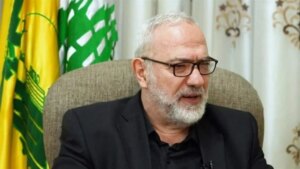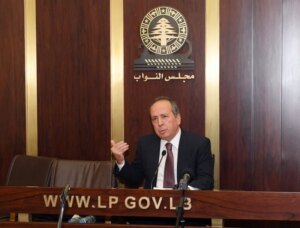
Deputy Wael Abu Faour, a member of the “Democratic Gathering” bloc, affirmed that Lebanon is going through a very sensitive stage, which requires the highest degrees of national responsibility, given the rapid developments and challenges in the region, stressing the importance of adhering to the national and Arab identity as a unified framework that preserves internal stability.
Abu Faour stressed the necessity that the sovereign decision, especially regarding war and peace, be the sole preserve of state institutions, considering that adopting a balanced national vision is the best way to protect Lebanon and avoid further internal divisions.
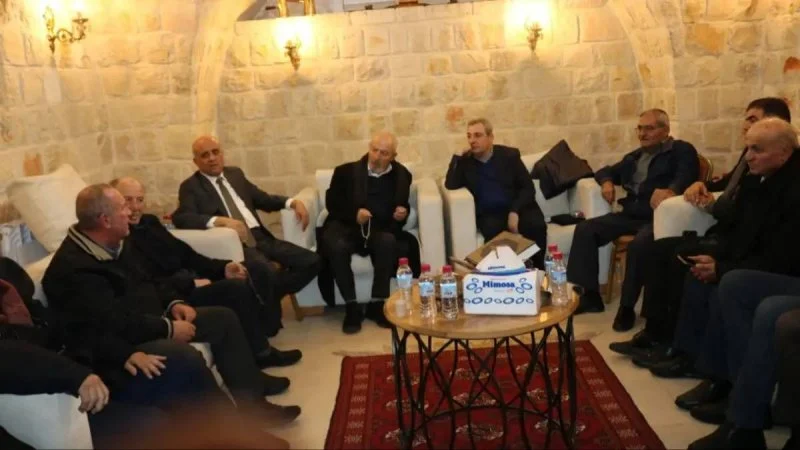
Abu Faour’s statements came during a political dialogue meeting at the invitation of the former President of the Union of Municipalities of Qalaa al-Istiqlal, Ahmed Zobian, at his home in the town of Mdoukha – Rachaya District, in the presence of a group of cultural, educational, syndicate and social figures, in addition to heads of municipalities, mukhtars and a large crowd of invitees.
The meeting opened with a speech by Zobian, in which he affirmed that the attendees are meeting in a comprehensive national Arab atmosphere, pointing out that Abu Faour is seen as a “political intellectual” in addition to his role as a deputy, in light of the need for an in-depth analysis of the prospects of the stage.
In his speech, Abu Faour noted the depth of the relationship that binds him to Zobian, describing it as a “deep-rooted relationship inherited from the party and the family, within a joint struggle path and a national Arab dream that accompanied Lebanon and the region.” He pointed out that the frustrations did not deter them from adhering to the national and Arab identity, warning that “deviating from it means tearing societies apart.”
He pointed out that Arabism today needs a contemporary concept based on “political reform, rights and duties, democracy, and civilized Arabism,” and that Lebanese nationalism in turn needs to be redefined, warning that the alternative to these unifying concepts is to slide into sectarianism, denominationalism, and conflicts.
He addressed regional developments, especially in Syria, considering that fueling sectarian divisions has undermined unity, and that the success of any new authority depends on its ability to accommodate all components. He warned that “the fall of the unifying idea in any Arab country pushes societies towards internal conflicts.”
Regarding the Lebanese issue, he believes that the country faces great challenges, the most important of which are “the confrontation with Israel and testing internal relations,” warning that Israel’s interest lies in “keeping Lebanon an open arena, whether through normalization or through fueling internal conflicts,” noting that some Lebanese statements give Israel “additional pretexts to continue its attacks.”
He stressed that the only solution to face these challenges is to adopt a comprehensive national vision based on the state, as the unified framework and the only party authorized to monopolize the sovereign decision, considering that “Lebanon cannot bear more than a truce agreement, and that any step towards normalization constitutes an explosion of internal risks.”
In his assessment of the official performance, he believes that the positions of the “President of the Republic, the Prime Minister, and the government” are rational, and the positions of the “Speaker of Parliament” agree with them in light of the current circumstances, praising the role of the “Lebanese Army” as a reliable national institution that enjoys the confidence of the Lebanese.
He pointed out that the recent negotiation initiatives, especially with regard to “the mechanisms for dealing with UNIFIL forces and regulating procedures in the south,” contributed to strengthening Lebanon’s position externally and mobilizing the support of its friends in the face of Israeli attacks.
At the local level, he praised the unity of position among leaders and activities, considering that it was a safety valve in the face of the repercussions of what happened in Syria, thanks to joint cooperation and the role of religious references.
Abu Faour concluded by emphasizing that the upcoming electoral entitlements must remain within the framework of legitimate political competition without sectarian or denominational polarization, stressing that the priority in the next stage should be “development competition and job creation,” considering that “the greatest gain remains the preservation of coexistence and the prevention of the reflection of political differences into differences between people.”