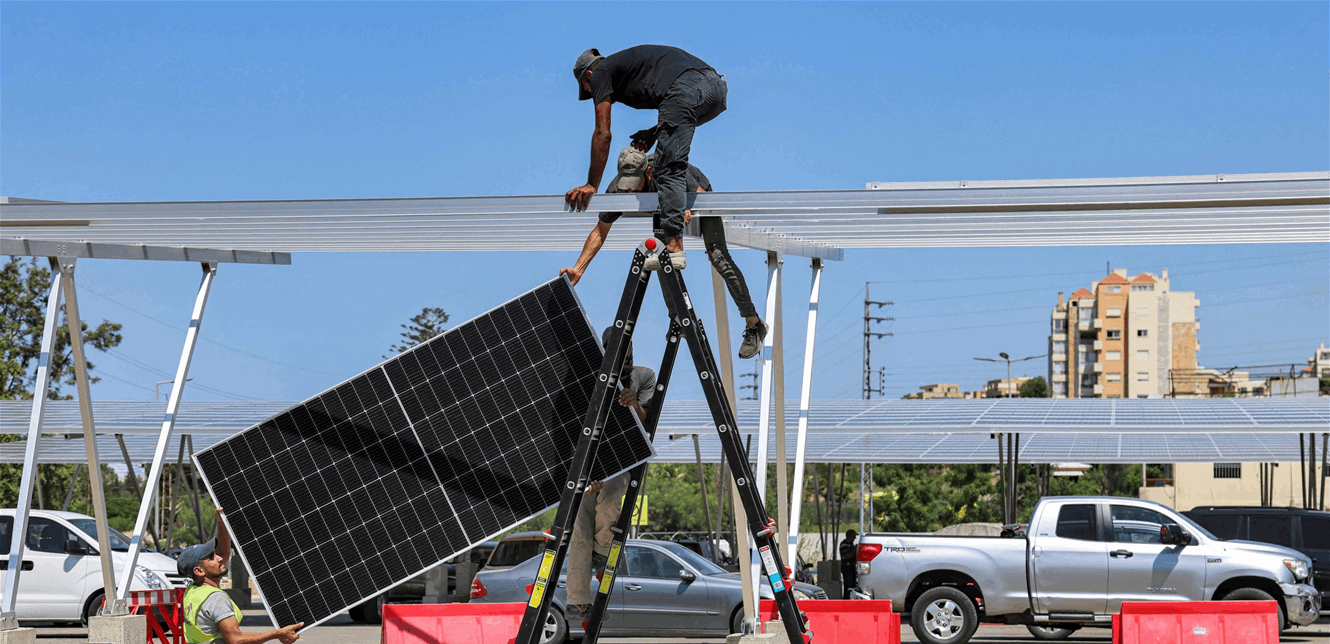
Between 2021 and 2026, Lebanon witnessed a significant decline in official electricity supply, limited to approximately one hour per day, which reinforced reliance on alternatives within neighborhoods. With this deterioration, the discussion shifted from just the cost of subscription and the quality of electricity to a deeper question about who has the capacity to produce electricity and how it is distributed fairly within buildings and neighborhoods, in a country where energy has become a daily reflection of the disparities between the capable and the incapable. Amidst this scene, generators declined in some areas as the number of subscribers decreased and many people turned to solar energy, leading to the emergence of collective energy as an unprecedented transformation after the “neighborhood generator” phase. In the generator model, production is centralized and customers are dispersed, with each apartment buying its share individually. Collective energy, on the other hand, reflects an opposite logic based on distributed production and shared ownership or management, where consumers become partners in decision-making, financing, and surplus sharing.
The pivotal shock was in 2022, when the lifting of subsidies pushed people to accelerate the transition to solar energy. As a result, the contribution of renewable energy rose to about 21 percent of the total energy supplied by the end of 2022. The expansion was not limited to the spread of solar panels, but also recorded additions of nearly 777 megawatts in 2021 and 2022, then the cumulative capacity of solar energy exceeded 1000 megawatts by the end of 2023, and continued to rise until the end of 2025. The significance of these figures goes beyond merely measuring technical volumes, it means that the energy production base has exited from a single monopoly and entered into thousands of surfaces, which automatically opens the door for sharing production within a building or group of buildings instead of each home remaining a prisoner of an individual solution. According to energy experts, this quantity has pushed owners of abundant energy production to revive the idea of “storage.” When the share of batteries reaches about 65 percent of the installed capacity, the goal becomes more than just operating devices in the time of the sun, towards building a capacity to distribute electricity temporally between day and night. This is the essence of any collective solution that aims to ensure continuity for all, not just for those most able to pay.
In the background, the market balance was clearly shifting. The share of Électricité du Liban (EDL) fell from 38 percent in 2018 to 12 percent in 2022, in contrast to the rise of private generators to 47 percent in 2022. This shift explains why people began looking for a third alternative, not the state alone nor the generator alone, but a local system that shares production and reduces dependence on fuel. On the legal level, the Decentralized Renewable Energy Law No. 318 of 2023 opened the door for the clearest form of collective energy through group net metering and metering for multiple tenants. In practice, a single building can act as a single energy unit, and calculate production and consumption in a way that allows for sharing the surplus instead of wasting it or restricting it to those who own the roof. The law also allows for the direct exchange of electricity between private parties within the property or between adjacent properties, and also allows for remote exchange through pass-through arrangements using the Électricité du Liban network, which is the point that transfers collective energy from the building level to the neighborhood level, because pass-through makes participation possible even when production is in one place and consumption is in another.
At the heart of the idea of collective energy, the “roof” is no longer just a neglected space above the building, but becomes a shared asset managed as any collective property, through a decision, a budget, maintenance, and distribution of shares. Here, the daily language of residents changes; from “subscription” and “bill” to “share” and “management” and “sharing.” Even the disputes that revolved around generator amps are replaced by more organized discussions about the size of the investment, the maintenance schedule, and how to calculate the surplus. More importantly, collective energy redefines justice within the building itself. In the “individual sun” model, whoever owns the roof or has the ability to pay guarantees greater energy, while others remain on the margins of the solution. In the collective model, the goal becomes to transform production into a shared service that reduces disparities between apartments, especially when coupled with storage that allows for the distribution of energy over the hours of night and day.
Economically, this formula offers radical solutions by reducing the fuel bill on the one hand, and stabilizing the cost of energy over a longer period on the other. The generator is linked to the price of diesel and its fluctuations, while a collective solar system is more linked to the cost of installation and maintenance distributed over a larger number of apartments. At the neighborhood level, collective energy becomes like a “social network for electricity.” When pass-through becomes possible, a building with surplus production at one point can feed consumption at another point, so new possibilities for cooperation between neighbors emerge instead of each building remaining an independent island. This shift in particular gives the transformation a vital dimension, because it connects energy to social behavior, mutual trust, and the ability of the local community to organize itself. In this context, Jihad Bitar, one of those in charge of the collective energy project in a residential building in the Mount Lebanon area, told “Lebanon24” that the idea began “as a simple question between neighbors: why should each of us pay alone for an individual solution if we can produce, store, and share?”. Bitar explains that the residents formed a small committee to collect the numbers and determine the share for each apartment according to consumption, then they agreed on a maintenance and monthly accounting mechanism “so that the partnership does not turn into a permanent dispute.” He adds that the biggest difference appeared after installing storage, as “electricity is no longer linked to the hours of the sun only, it has become possible for us to distribute it over night and day more fairly, and over time our reliance on the generator and its noise and smell has decreased, and most importantly, the decision is no longer in the hands of one supplier but in the hands of the building’s residents.”
With all that, the experience remains governed by the question of governance: who manages? Who monitors? And how are disputes resolved? Collective energy does not only succeed with panels and batteries, but with clear rules, through transparent measurement, an understandable accounting mechanism, and a management formula that prevents turning the “partnership” into a new monopoly within the building. The simpler and more just these rules are, the greater the chances that the experiences will expand from limited cases to a model that is repeated in multiple neighborhoods, instead of relying on government promises, the latest of which was what the government of President Nawaf Salam gifted the Lebanese during the holiday season, which is “the gift of darkness.”
The conclusion of the transformation is that Lebanon has begun to move from a subscription economy based on buying energy from a generator, to a sharing economy based on sharing production and managing it within the local community. The fundamental difference is that the generator sells you electricity, while collective energy redefines you as a contributor to its production and distribution, and opens an opportunity to reduce pollution and noise associated with generators whenever decentralized solar networks expand.