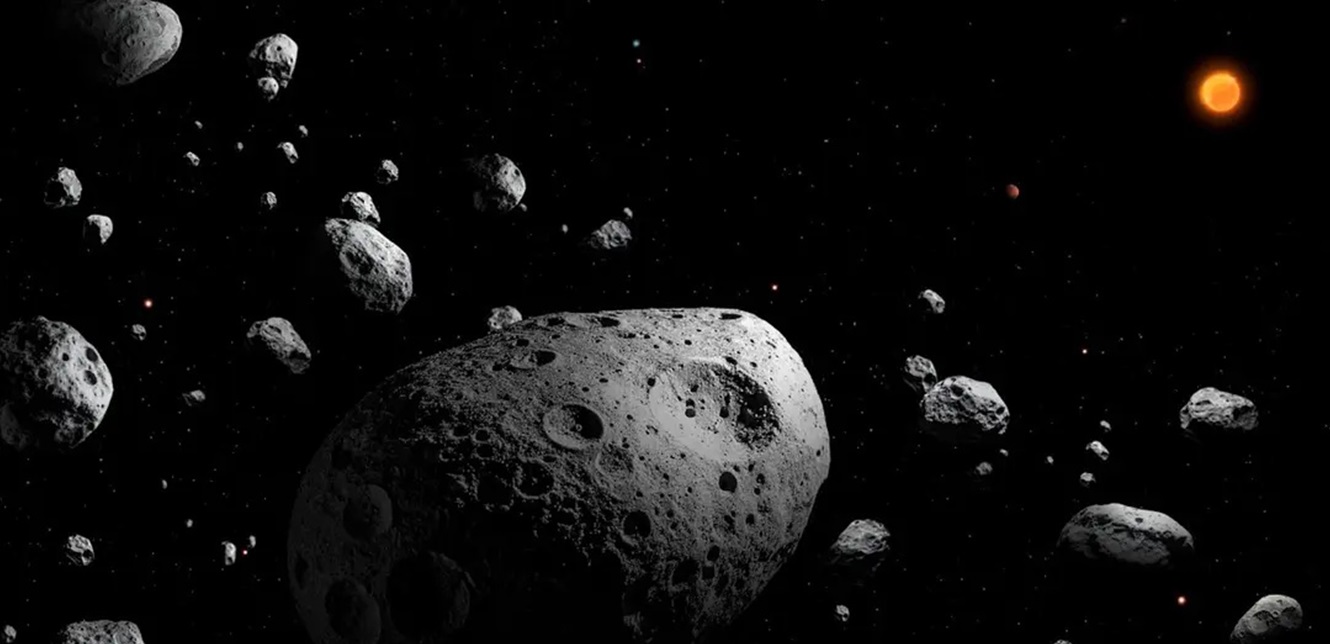
The Vera C. Rubin Observatory has detected a rapidly spinning asteroid, setting a new record as the fastest asteroid with a diameter greater than 500 meters ever observed.
This asteroid, named “2025 MN45,” completes a full rotation around its axis in a very short period of “only 1.88 minutes.” This discovery was announced during the “First Look” event for the Vera C. Rubin Observatory, affiliated with the National Science Foundation and the U.S. Department of Energy in June 2025, as part of a group that includes about “1,900 new asteroids” recently discovered by the observatory, including “19 super or ultra-fast rotating asteroids.”
### An “Exceptionally Fast-Rotating” Asteroid
The study of these new asteroids was led by Dr. Sarah Greenstreet, an assistant astronomer at NSF NOIRLab and head of the Near-Earth Objects and Interstellar Objects group within the Rubin Observatory’s Solar System Science Collaboration. The results of this study were published in “The Astrophysical Journal Letters.”
The scientific team relied on data collected during approximately “10 hours of observation over seven nights” in April and May of last year, during the early commissioning phase of the observatory. According to a press release, this research paper is the first peer-reviewed scientific work using data from the “world’s largest digital camera,” the Rubin Observatory’s LSST camera.
### The World’s Largest Camera
The “LSST” camera, which is the size of a car and has a resolution of “3,200 megapixels,” was installed in the observatory during March 2025. The system includes a primary/tertiary mirror with a diameter of 8.4 meters and a secondary mirror with a diameter of 3.5 meters, weighing more than “3,000 kilograms.”
Regina Rameika, Associate Director for High Energy Physics at the U.S. Department of Energy, said:
“The Department of Energy’s investment in the advanced technologies of the Rubin Observatory, especially the LSST camera, is proving its great importance. Discoveries like this ultra-fast asteroid are a direct result of the observatory’s unique ability to provide high-resolution, time-varying astronomical data, pushing the boundaries of observation to new horizons.”
### What Do Fast-Spinning Asteroids Tell Us?
The high-speed rotation of asteroids provides valuable information about the “early stages of solar system formation.” Rapid rotation may indicate a previous collision with another space object, or that the asteroid was part of a larger body that fragmented into smaller pieces.
The rotation rate also helps scientists understand the “composition and internal structure of asteroids.” If an asteroid is rotating at an incredible speed without disintegrating, it must be composed of a very solid material.
The asteroid “2025 MN45” has a diameter of about “710 meters” and is a main-belt asteroid, rotating once every 1.88 minutes, making it the “fastest known asteroid with a diameter greater than 500 meters.”
Greenstreet said:
“It is clear that this asteroid must be composed of a material with very high strength in order to remain intact despite its rapid rotation. Our calculations indicate that it needs a cohesion similar to that of solid rock, which is a bit surprising, because most asteroids are believed to be of the ‘rubble pile’ type, i.e., composed of small rocky fragments held together by gravity.”
### The Future of the Vera C. Rubin Observatory
These discoveries offer a glimpse of what the near future holds, as the “Legacy Survey of Space and Time (LSST)” mission is scheduled to begin in the coming months. This mission will repeatedly survey the southern hemisphere sky at night over “10 years,” creating an ultra-high-resolution and wide-ranging timeline of the universe.
Luca Rizzi, Program Director for Research Infrastructure at the National Science Foundation, said:
“The Rubin Observatory will find things that no one even knew to look for. As the LSST survey begins, this massive, fast-spinning asteroid will join a flood of new information about our universe.”
For his part, Aaron Roodman, LSST Deputy Project Manager and Professor of Particle Physics and Astrophysics at SLAC, added:
“The ability to discover thousands of asteroids in a short period of time, and learn so much about them, reflects the scale of the discoveries that the ten-year survey will reveal.”