Every time a wave of internal protests shakes Iran, talk of overthrowing the regime from within resurfaces, a recurring theme in the ongoing conflict between the Islamic Republic and its regional and international adversaries. Since the victory of the Islamic Revolution in 1979, efforts to weaken the Iranian regime have not ceased, exploiting economic crises, social disputes, and political tensions, turning them into a launchpad for a radical change in the structure of government.
However, these attempts were not limited to internal factors alone, but were accompanied, as many reports and analyses indicate, by foreign intelligence interventions, most notably the Israeli role. The “Mossad” is accused of working to infiltrate the protest scene as part of a long-term strategy adopted by Israel in coordination with the United States, based on moving the confrontation to the Iranian depths, after it was impossible to resolve it militarily or politically from the outside.
Writer and political analyst Ibrahim Bayram provides a calm and realistic view of the nature of the current protests, their internal and external impact, and their potential repercussions on Iran’s regional role and its support for resistance forces, in an interview with .
Bayram believes that the protests in Iran today are not a unique or unprecedented event, as the Iranian regime has faced many waves of protests since the Islamists took power. He points to the existence of internal forces opposed to the regime that are constantly working to exploit the weaknesses within the Iranian state, seeking to invest popular demands in order to re-emerge on the political scene.
Bayram emphasizes that what distinguishes this round of protests is that it is weaker in size and impact than its predecessors, pointing out that the uprisings that Iran witnessed in the past were more widespread and more powerful, and that the opposition movements to the regime at that time were more organized and present. Today, these forces seem tired, far from their peak, and move out of helplessness and despair more than out of real action and influence.
Accordingly, Bayram believes that these protests do not pose a real threat to the Iranian regime at the present time, which explains, in his opinion, the authorities’ failure to resort to high levels of violence in dealing with them. He acknowledges, in return, that the economic situation in Iran is difficult, as a result of the sanctions imposed on the Islamic Republic, but he points out that similar economic crises affect even major countries such as France and a number of European countries, even though they are not subject to embargoes or sanctions, asking: What about a country that is subject to suffocating economic pressures like Iran?
Bayram adds that Iran not only faces internal challenges, but is also subjected to intense external pressure, and to what resembles an open war by the Israeli enemy with American support, where it witnessed continuous targeting for 14 days, in a clear attempt to weaken it. He mentions that the slogan of overthrowing the Iranian regime is an old American-Israeli goal, and has been declared for many years.
In response to a question about whether the time has come to achieve this goal, Bayram rules out this scenario, pointing out that even Western reports themselves do not bet on the possibility of overthrowing the regime through these demonstrations. He likens the impact of the current protests to a “headache” for the regime, meaning that they may cause it temporary annoyance and pain, but they do not have the ability to overthrow it or “cut off its head.”
As for the impact of the current Iranian reality on the financing of Hezbollah and resistance movements, Bayram affirms that he does not see any impact as long as things remain within their current framework, and the real impact can only occur in the event of the fall of the Iranian regime, which is a scenario he considers unlikely in the foreseeable future, and in this case only Hezbollah may be directly affected.
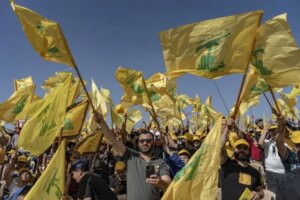
Bayram points out that since the outbreak of the war in Gaza, and then the extension of the confrontation to Lebanon, there has been a clear endeavor to strike all of Iran’s arms abroad. However, Tehran, in return, adhered to what it had left of its cards of strength, especially Hezbollah and the Houthis, in addition to some Iraqi forces, considering that these forces constitute fundamental pillars in its regional strategy.
He emphasizes that Iran, as long as the regime remains in place, will not abandon these cards, because they constitute external fortification elements and tools of deterrence and influence that it needs in the face of international and regional pressures. Therefore, it will continue to support Hezbollah, Hamas, Islamic Jihad, and the Houthis, as they are an integral part of its power system, as long as the Iranian regime exists and is able to continue.