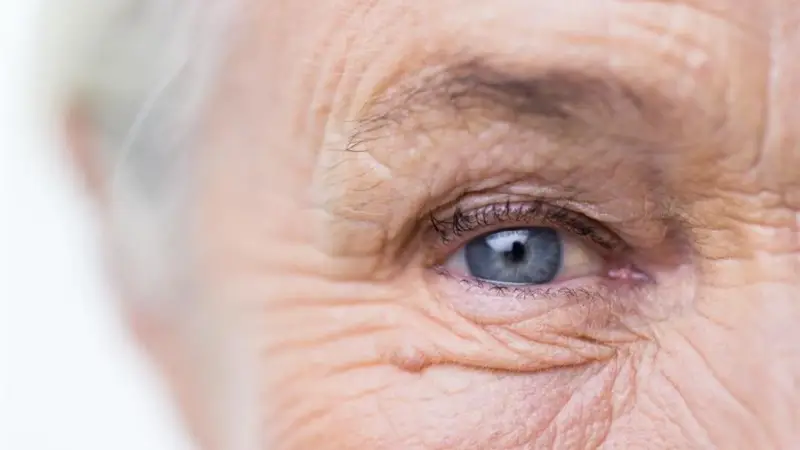
Growing evidence suggests that facial features may reveal more about the health of our brains than we think. In two separate studies conducted by Chinese researchers, it was found that facial appearance, specifically “crow’s feet” wrinkles (lines around the eyes), may be an early indicator of an increased risk of dementia and Alzheimer’s disease.
Wrinkles Around the Eyes
Dr. Li Zao, the lead researcher in the study, explains: “We discovered that it may be a non-invasive diagnostic tool.” This is what the research team concluded, based on a large-scale study from the “UK Biobank,” which included health data of 195,000 people over the age of sixty for 12 years. The results showed that people who looked older than their actual age were 61% more likely to develop dementia, even after taking into account factors such as smoking, education, and physical activity.
The second study provided tangible physical evidence. By analyzing images of 600 elderly people in China using advanced digital techniques, researchers found that deep and multiple wrinkles around the eyes doubled the risk of measurable cognitive impairment. In fact, each additional year a person appeared older than their age was associated with a 10% increased risk of cognitive decline.
Why the Eye Specifically?
The reason lies in the nature of this vital area. The skin around the eyes is the thinnest in the body, making it a “magnifying mirror” that reflects accumulated environmental damage, especially from ultraviolet radiation.
This damage is not limited to the surface; rather, it stimulates a state of oxidative stress and chronic low-grade inflammation that spreads throughout the body and reaches the brain, where it contributes to accelerating the aging of nerve cells. Also, the early appearance of deep wrinkles in this area may indicate a decline in the efficiency of self-repair systems, such as collagen production and antioxidant defenses, which are the same mechanisms that protect brain cells.
The importance of these findings lies in the concept of “shared disease-causing mechanisms,” which explains how the body ages as an integrated unit. The age we see on the face is not just a number, but a visual estimate of internal biological age.
When this biological age precedes chronological age, it increases the susceptibility of the entire body, including the brain, to age-related diseases. Chronic inflammation is the common link between skin aging and brain deterioration.
This risk was not evenly distributed. The study found that people who are obese, spend a lot of time in the sun in the summer, and have a genetic predisposition to Alzheimer’s disease were more susceptible to this association.
These results confirm the complex interaction between genes, environment, and lifestyle in determining the course of our health.