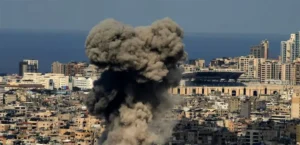
In light of the events and statements accompanying the meeting between U.S. President Donald Trump and Israeli Prime Minister Benjamin Netanyahu, especially those related to “Hezbollah” and Lebanon, sources familiar with the atmosphere of the party revealed a different reading from that circulated in the media, considering that what was issued falls within the category of political messages and psychological pressure, rather than a real trend towards a comprehensive escalation.
The sources believe that the essence of the Trump-Netanyahu meeting was related to Iran, while Gaza and Lebanon came later. They explain that Netanyahu did not achieve his goals in either the Gaza or the Lebanese file, which makes the escalatory rhetoric preceding the meeting closer to political threat than to actual preparation for war. They draw attention to the fact that Israel achieves its goals in Lebanon through attacks and pressure without sliding into an all-out war, which raises a logical question: Why resort to a costly war when it can impose facts without it?
The sources point to an advanced opinion within the American administration that focuses on containing weapons and disabling their role, while maintaining a minimum level of stability in Lebanon, and gradually achieving goals through continued Israeli attacks and American pressure, and taking advantage of internal Lebanese factors. According to this logic, these circles believe that entering into an open war may not achieve the desired results, but may lead to additional complications.
The sources emphasize an important point, which is what they describe as direct American guardianship over Lebanese affairs, asking: If Washington is managing this file directly, why push Israel to launch a war on Lebanon? They consider that placing Lebanon in third place in Trump’s statements is further evidence of this, and reflects the position of the Lebanese file on the scale of American priorities.
The sources also draw attention to what they describe as a remarkable matter, which is Israel’s recognition of what is called the “Land of Solar,” in a message that, in their opinion, indicates that Israel is trying to suggest that the era of “Greater Israel” has begun, and that the region extending between the Red Sea and the Mediterranean Sea has become within the sphere of Israeli influence and direct hegemony.
The sources believe that Israeli actions in Qatar, Syria, and Lebanon are further evidence of this trend, which aroused clear Egyptian concern, and prompted Cairo to move towards Lebanon, in the hope that some Arab countries would learn lessons from this escalating path.
In light of this situation, the most important question arises, according to the sources: Can the resistance project in Lebanon and the region be considered over? The sources answer that resistance is not an administrative decision or a project that is canceled by a political decision, but rather it is a choice born by peoples in the face of Israeli hegemony, impunity, and encroachment. They believe that this reality, on the contrary, reinforces people’s desire to adopt this option, regardless of the calculations of the regimes.
The sources cite the Beit Jann incident and the confrontation that took place with the enemy forces that entered it, considering that it carried clear indications that people will not accept the violation of their privacy or the imposition of facts by force.
The sources conclude by saying that resistance in its essence is a direct reaction to a harsh and painful reality, and it may be delayed in appearing, but it does not die, but rather stems from suffering, as happened in the beginnings of the resistance in Lebanon, when the bitter reality imposed itself, and the confrontation was a natural result of it.