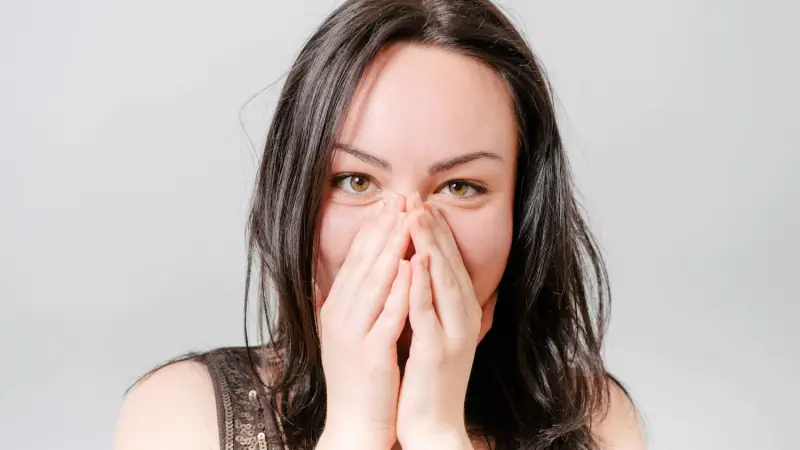
Have you ever wondered why our faces turn red when we feel embarrassed? Interestingly, when we feel embarrassed, this involuntary reaction can feel like an added penalty that makes the situation worse. However, evolutionary science suggests that blushing may have social benefits.
Blushing:
Blushing is a noticeable physical reaction that occurs when we experience emotions such as embarrassment, shame, or self-consciousness. This redness occurs as a result of a short-term increase in blood flow to the skin of the ears, face, neck, or chest.
When emotions trigger this redness, the sympathetic nervous system, which is responsible for controlling automatic body functions, is activated, and adrenaline (epinephrine) is released. This leads to the relaxation of the small muscles found in the walls of blood vessels.
Although adrenaline usually causes vasoconstriction in the body, in the face, the opposite happens, leading to their dilation. This means more blood flows to the skin, giving the face a feeling of warmth.
As a result of this sudden flow of blood near the surface of the skin, our skin turns red.
This redness is more noticeable in people with fair skin. While it may be less visible or even invisible in dark skin, the same physiological process occurs.
Regardless of whether others are able to see the redness or not, you are likely to feel warmth or tingling in your face.
The Social Role of Shame:
It may be surprising to learn that shame has a social role. It seems to contribute to building trust with others, as people often view blushing as a sign of honesty and sincerity, especially since it is an involuntary reaction.
Blushing can indicate a non-verbal apology for a social error, helping to maintain social bonds after it occurs.
Different emotions can cause us to blush, but the mechanism remains the same: increased blood flow to the face, making us feel warm.
The difference lies in the fact that blushing caused by anger, for example, stems from excitement and frustration, while blushing caused by embarrassment arises from self-consciousness and social emotion.
People blush for various reasons.
- For example, one study found that children with social anxiety blushed significantly when they received excessive praise, compared to moderate praise or no praise.
- In a later study, researchers discovered that children who scored high on a narcissism scale, i.e., those who have an exaggerated sense of self-importance, desire admiration, and lack empathy, only blushed when they received moderate praise.
The researchers pointed out that the reason for this is that the praise given did not match how well the child believed they had performed.
Who is more prone to shame?
Women and young people blush more than others. This may explain why blushing is often associated with youth, vitality, and fertility.
People with social anxiety are also more prone to blushing.
But as we age and gain more life experience, we blush less out of shame. This may indicate that we have become more aware of social norms, or that we are less disturbed if we violate them.