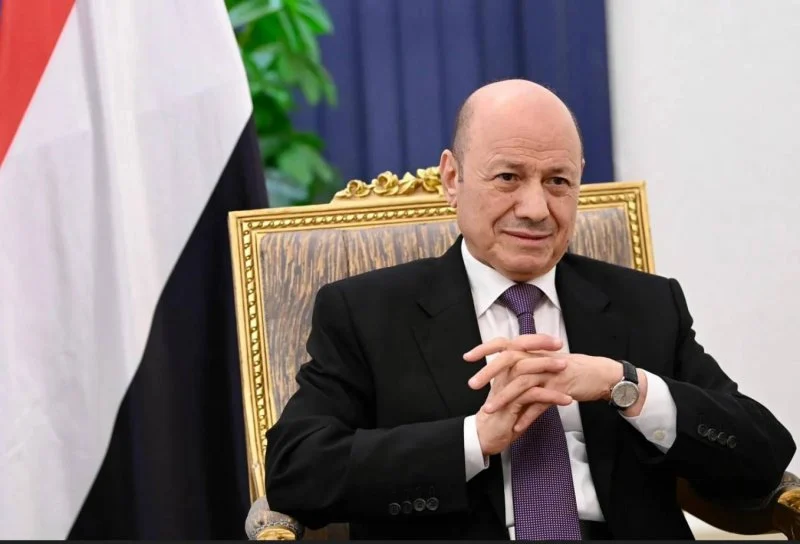
The Chairman of the Presidential Leadership Council in Yemen, Rashad Al-Alimi, affirmed today, Tuesday, that Yemen cannot bear to open more fronts of attrition. He stressed, saying: “We are strong with the support of the coalition led by Saudi Arabia.” He announced the cancellation of the joint defense agreement with the United Arab Emirates, demanding that the Emirati forces withdraw from Yemeni territory.
In a televised address, Al-Alimi stated that “Yemen has never failed to confront terrorist threats,” noting that “the Transitional Council refrained from responding to our calls to address differences and make decisions,” and considered that “shipping weapons in two ships from the port of Fujairah in the Emirates to the Transitional Council is an escalatory step.”
Al-Alimi explained that “the UAE’s role has become directed against the people of Yemen,” demanding that all UAE forces leave Yemeni territory within 24 hours.
He also announced the imposition of a 72-hour air, sea, and land blockade in Yemen, and the declaration of a state of emergency for 90 days, extendable, explaining that this blockade does not include what is issued by the coalition.
He added that he directed the “Nation Shield” forces to move and take over the camps in the governorates of Hadramout and Al-Mahra, announcing the granting of the governors of the two governorates the necessary powers to manage their affairs.
Al-Alimi affirmed that “the blood of Yemenis is a red line that cannot be compromised,” rejecting “the exploitation of the southern issue to disrupt constitutional institutions,” and announced the taking of additional decisions to protect civilians, which will be announced later.
He affirmed that the Presidential Leadership Council is the only constitutional framework for addressing disputes, considering the behavior of the Southern Transitional Council “an unacceptable rebellion that is not justified,” stressing that “no one has the right to employ the southern issue to achieve illegitimate political goals,” and that “no one has a mandate alternative to the will of the people of the South.”
Al-Alimi pointed out that “the southern issue is just and is at the heart of the state project that we are fighting for,” reiterating that “the Transitional Council refrained from responding to our calls to address differences and make decisions.”
Al-Alimi’s statements come hours after the official spokesman for the coalition forces, Brigadier General Turki Al-Maliki, announced that two ships entered on Saturday and Sunday, December 27-28, 2025, from the port of Fujairah to the port of Mukalla without obtaining official permits from the Joint Forces Command.
Al-Maliki explained that the crew of the two ships disabled the tracking systems and unloaded large quantities of weapons and combat vehicles to support the forces of the Southern Transitional Council in the governorates of Hadramout and Al-Mahra, with the aim of fueling the conflict, in explicit violation of the imposition of de-escalation, and violation of Security Council Resolution No. 2216 issued in 2015, according to the Saudi Press Agency “SPA.”
He added that, at the request of the Chairman of the Presidential Leadership Council, the coalition air forces carried out a limited military operation this morning targeting the weapons and combat vehicles that were unloaded in the port of Mukalla, after documenting them, and in accordance with international humanitarian law and its customary rules, and in a manner that ensures that no collateral damage occurs.
Al-Maliki affirmed the coalition’s continued de-escalation and imposition of calm in Hadramout and Al-Mahra, and preventing the arrival of any military support from any country to any Yemeni component without coordination with the legitimate Yemeni government and the coalition.
In the same context, the coalition announced the end of the limited military operation in the port of Mukalla and the return of the situation to normal, confirming that no human casualties or collateral damage were recorded, including infrastructure and facilities.