– Amal Suheil
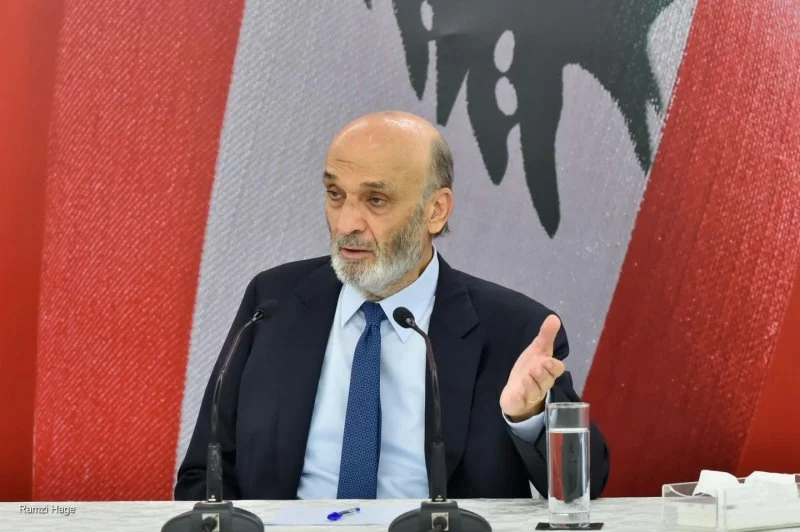
The relationship between the Lebanese Forces party, led by Samir Geagea, and the rest of the Lebanese components seems tense, as he continues his attack on the Shia duo, clashes with the First Presidency, and seeks to impose his control over the Sunnis in Lebanon, claiming Saudi support for him in this regard. So what is the “Lord of Maarab” seeking?
Three Main Goals for Samir Geagea
Political analyst and writer Ibrahim Bayram believes that the head of the Lebanese Forces party, Samir Geagea, has three main goals:
- The First Presidency, as Geagea clearly aspires to reach this position.
- Controlling the Christian arena and monopolizing it, repeating the experience of Bachir Gemayel in uniting Christian forces, but this time by eliminating any party other than the Forces, including the Kataeb Party, by marginalizing it.
- Marketing himself nationally in the manner of Bachir Gemayel, who paved the way for this before reaching the presidency, as he enjoyed the satisfaction of some Sunni parties. Therefore, Geagea is repeating this experience, trying to ignite a permanent conflict with the Shiites, hoping to gain Sunni support.
Attempting to Subdue the Sunni Arena
Bayram points out that Geagea is trying to present himself as the guardian of the Sunnis of Lebanon, and the evidence for this is the statement of Forces MP George Okeiss that the Sunni MP for Zahle follows the instructions of Maarab, which aroused the discontent of Sunni MPs. Consequently, Geagea seeks to subdue the Sunni arena because it is considered the weakest link in the Lebanese scene, and the evidence for this is the influence of a person like Abu Omar in this arena.
Betting on Gulf Cover and Escalation with the Duo
Bayram explains that Geagea believes that he enjoys Gulf immunity or support, and he did not hide this by saying: “Whoever has a strong relationship with Saudi Arabia does not need anything else.” Therefore, he acts on this basis, trying to accelerate his steps by escalating the daily confrontation with the Shiites and the duo in general. After focusing on Hezbollah, he began attacking President Nabih Berri, to say: “I am the one who can later achieve the dream of taming the Lebanese arena and ending all manifestations of objection,” and this is Geagea’s role at this stage.
Clash with the First Presidency and Establishing Leadership
Regarding his conflict with the Presidency of the Republic, Geagea is trying to shorten the stages unlike President Joseph Aoun, and he also cannot tolerate the presence of anyone who may pose a threat to him in the Christian arena, as he believes that the President may think of establishing a parliamentary bloc or allying with other parties, which may affect the Christian arena. In this context, he is also trying to tame the First Presidency, even morally, meaning that “he has no superior,” and he believes that he can harm whoever he wants, and he operates according to this logic.
After attacking the party and President Berri, and President Aoun currently, the Third Presidency was not spared from his criticism either, as he attacked it at one point despite the alliance between him and President Nawaf Salam.
Bayram believes that the First Presidency is trying to draw a line of objection to stop this encroachment of the Forces, despite its constant endeavor to present itself as independent and above everyone, and therefore it is trying to build relationships with various parties. From this standpoint, the “Lord of Maarab” directs an implicit accusation to the First Presidency of cooperating with Hezbollah instead of working hard to end the issue of weapons.
Bayram considers that Geagea sees the clash with the Presidency, in the first period, as a “beautiful journey,” even with its Maronite symbolism, because he considers himself the guardian of the Maronites in Lebanon. He seeks to complete this by acquiring the parliamentary share of the Free Patriotic Movement, thus consolidating his leadership in the Christian arena, and then in the country as a fait accompli.