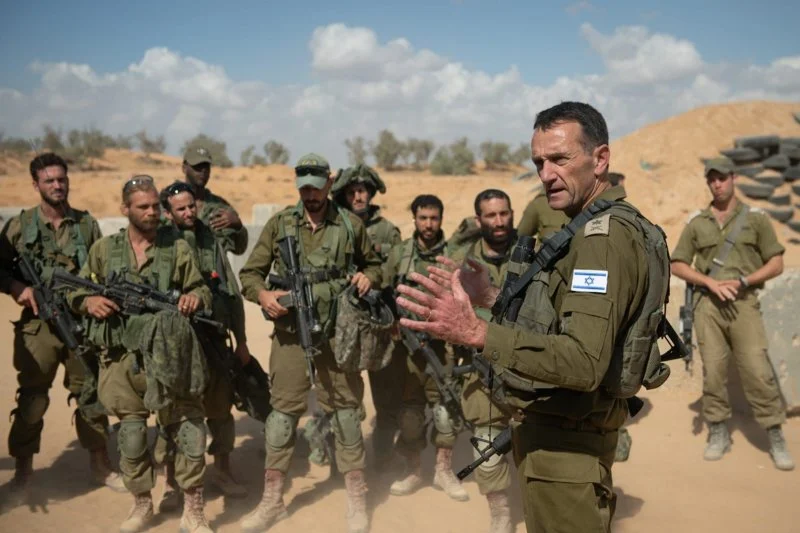
In rare confessions from within the Israeli army, reserve officers stationed on the “Yellow Line” in the Gaza Strip revealed a deep sense of frustration and deteriorating morale, due to strict operational restrictions and the inability to impose control west of this line.
Yedioth Ahronoth newspaper quoted a reserve lieutenant colonel, who was part of the force that controlled the Yellow Line two weeks ago, as saying: “We see Hamas organizing its ranks, planting explosives, and rebuilding infrastructure, but we are not allowed to shoot except after conclusively verifying the identity of the suspect, and after obtaining approval from the high command.”
He added: “It is understood that the Israeli army is the only party capable of disarming Gaza, but in practice, control has been confiscated and transferred to the Americans. Without the approval of the United States, nothing can be done.”
According to other officers who spoke to the same newspaper, the army is losing actual control over what is happening west of the Yellow Line, where Hamas members roam in civilian clothes or vests, set up tents, and reactivate local government institutions, without the ability of Israeli forces to intervene.
A reserve major recently stationed in the sector said: “We control east of the Yellow Line, but west of it we have no military presence. There, Hamas moves completely freely. This is a worrying and frustrating situation.”
Another officer pointed out that “a golden political opportunity is being lost,” asking: “What prevents us now from pushing forward a political plan to end Hamas? We have sacrificed more than 300 days of war, and here Hamas is recovering. We are going in circles, and no one understands why we are waiting.”
In light of this leadership ambiguity, the Israeli army revealed an incident of bombing a school in the Al-Daraj neighborhood north of Gaza on Friday, which resulted in the death of 3 children, after an Israeli force opened fire without obtaining the required approval from the Chief of Staff, considering the target was “sensitive.”
The army said in a statement: “The incident is being investigated, and we express our regret for any harm caused to innocent people.”
However, initial investigations, according to what the newspaper reported, showed that the force claimed to have spotted “suspicious targets,” while local sources confirm that the building was housing displaced families, and that the bombing led to some residents being burned alive under the rubble.
According to the officers, the center of decision-making is no longer in Tel Aviv but in the White House, as one of them says: “The army alone is capable of disarming Gaza, but today it is just an executive tool waiting for the American green light.”
They fear that what they call the “historic opportunity” will pass without investment, and the army will find itself after months facing a more powerful and organized Hamas, supported by a new financial and administrative infrastructure, all of which is happening under the eyes of soldiers who are prevented from acting even when watching their opponent directly.
In contrast to the Israeli leadership’s talk of “victory,” the facts on the ground, according to these testimonies, show that the resistance is rebuilding itself, while the future of Gaza remains suspended between incomplete political tracks, unclear agreements on disarmament, and partial Israeli withdrawals that have not yet produced a final vision for managing the sector.
With the faltering of security and international arrangement projects, a fundamental question arises as to whether Israel is actually capable of imposing a new equation in Gaza, or whether it will remain a prisoner of external calculations and interim policies that do not guarantee it long-term stability.