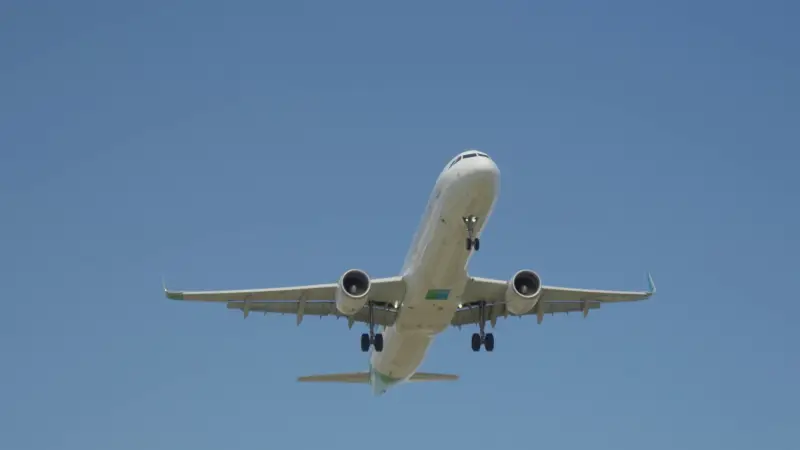
A study concluded that air travelers are exposed to remarkably high concentrations of ultrafine particles.
The study showed that levels of these particles during boarding and taxiing were significantly higher than the limits that the World Health Organization considers high.
Pollutants in aircraft
A team of French researchers, including scientists from the University of Paris Cité, designed a set of devices and transported them by air with passengers from Charles de Gaulle Airport in Paris to various European destinations. These devices were placed on an empty seat in the front rows or in the aircraft galley.
Ultrafine particles are invisible to the naked eye and are often overlooked by traditional monitoring methods, which is why they are not subject to air pollution laws.
In 2021, the Dutch Health Council and the World Health Organization highlighted increasing evidence that ultrafine particles have a negative impact on our health.
This included 75 studies, most of which focused on lung inflammation, high blood pressure, and heart problems, as well as their effects on fetal development.
Despite this, technical differences between the studies prevented the World Health Organization from establishing a unified standard. A subsequent study of approximately 11 million people in the Netherlands revealed that exposure to ultrafine particles for several years is associated with premature deaths, including lung cancer.
Land or air… which is more dangerous?
But there is some good news for air travelers. Ultrafine particle pollution inside the aircraft was very low when the aircraft was flying at high altitudes in relatively clean air.
On the ground, the situation was different. In the new study, the highest concentrations of ultrafine particles were recorded during passenger boarding and while the aircraft was taxiing.
Average levels were more than double what the World Health Organization considers high.
Once the aircraft took off, this polluted air was gradually removed from the cabin, but it rose again on approach to landing, possibly due to the high concentrations near flight paths and downwind from airports. This pattern was also observed at arrival airports.
The situation was similar for black carbon, or soot particles. These particles were also at their highest levels when the aircraft was at the airport.
This is a major concern, especially with projections that the number of air travelers worldwide will exceed 5 billion passengers this year for the first time. Aircraft remain an important source of pollution, with limited controls compared to road traffic and industry.
A separate review of health studies revealed a lack of research on the impact of air pollution inhaled by more than two million civilians and military personnel working at airports around the world.