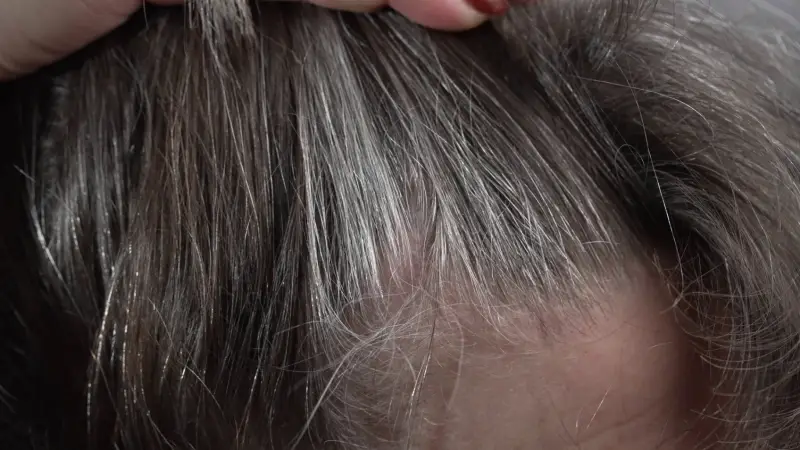
She added that the rate at which gray hair appears varies from person to person, but most of us begin to notice an increase in gray hair in our thirties or forties, according to the American Academy of Dermatology,” explaining that “around this time, pigment stem cells, which are hair follicle cells responsible for depositing pigment in the hair shaft, may begin to decline or malfunction.”
Gray hair
Meanwhile, George Cotsarelis, head of the Department of Dermatology at the Perelman School of Medicine at the University of Pennsylvania and a researcher of hair follicle stem cells, said according to the “Washington Post”:
* Not much is known about why pigment stem cells die.
* There are several reasons, including stress or DNA damage.
* It is believed that it may prevent these stem cells from surviving.
* This process is known as cellular aging, and causes “hair to gradually lose its color over time.”
* Strands of hair that were black, brown, red, or blonde begin to emerge from the follicle gray or silvery white.
* Some people also notice that their gray hair becomes coarser.
Age is important in the graying process
Age remains a major factor in determining when gray hair appears.
A 2012 study of more than 4,000 participants found that nearly three-quarters of people between the ages of 45 and 65 were at least partially gray.
But experts are increasingly viewing this phenomenon as a “dynamic process,” according to Natasha Mesinkovska, a dermatologist at UCI Health, who has studied hair graying.
Previously, experts considered graying to be inevitable as hair ages. Recent research suggests that “the pigmentation pattern is more vital than constant,” according to Mesinkovska.
This means that some factors may have a greater impact on the graying process than you think.
Genes have a big impact
Genes are not the only influencing factor, but they play a major role, meaning that a person may go gray at the age that their parents did.
Scientists have discovered genes that appear to play a role in graying hair, and may also affect other characteristics such as baldness, eyebrow shape, and beard density.
Research has shown that white people tend to go gray at a younger age than those of African and Asian descent, and that natural blonds may experience a higher percentage of gray hair earlier.
Early graying of hair, that is, before the age of twenty, before the age of twenty-five, and before the age of thirty, also appears to be affected by genes.
Mesinkovska said that one genetic variant, called IRF4, is “strongly associated with early graying.”
Although rare, some genetic disorders, such as Griscelli syndrome, a condition that causes pigmentation problems, can lead to gray hair from birth.
Men and women are equally likely to develop gray hair, but biological sex may affect where early gray hair appears: men tend to develop gray hair around the sideburns and temples, while women often notice gray hair appearing around the front of the head first.