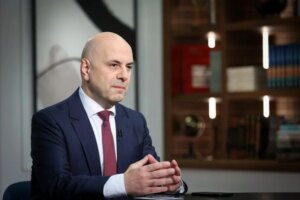
He explained that the main goal is to transform from a rentier economy based on consumption and imports to a productive and investment economy capable of competing, noting that 85% of Lebanese consumption is imported, while exports do not exceed $3 billion annually, which calls for a change in the structure of the economy.
Al-Bisat pointed to the need to move from an economy based on unproductive borrowing to an economy based on real investment, and from an economy with weak institutions to an economy based on governance and transparency. He stressed that economic justice is essential and includes addressing regional and gender disparities and ensuring that all members of society benefit from any future growth.
He affirmed that Lebanon possesses the capabilities that qualify it to achieve this vision, from human capabilities, natural resources, geographical location, and expatriate energy, noting that the country has always been able to reach better levels, but achieving this today requires facing challenges and embarking on real reforms.
He considered that the reform should include all sectors in parallel, from electricity, communications, infrastructure, and roads, in addition to rebuilding institutions and reconstruction, stressing that what investors are waiting for is clear evidence of the start of implementing reforms, which will allow the recovery and growth to begin.
Regarding the Beirut – 1 conference, Al-Bisat considered that it achieved an important result by breaking the economic isolation from Lebanon, revealing the participation of about 150 investors and businessmen from several Arab countries, including Qatar, Kuwait, the Emirates, and Saudi Arabia. He affirmed that the conference showed the existence of real investment opportunities and that the government presented a realistic narrative based on reform in exchange for investments as soon as the appropriate conditions are available.
He pointed out that the next stage will include direct follow-up to the results of the conference by preparing preliminary conferences leading up to Beirut – 2 in 2026, provided that these steps are linked to the implementation of the committed reforms.
Regarding the financial gap law currently being worked on in cooperation with the International Monetary Fund, he explained that the Prime Minister, the Ministry of Finance, and the Banque du Liban are working on it on a daily basis, stressing that the goal is to revive the banking sector and secure a fair solution for depositors. He affirmed that the repayment of deposits will be gradual, taking into account the distinction between small and large deposits without writing them off, and that the burden of losses will be distributed between the state, the Banque du Liban, and the banks, while preserving the state’s capabilities and monetary policies.
He pointed out that any restructuring will be accompanied by a natural merger of banks, as happens after crises, because an active banking sector is a prerequisite for the return of growth. As for the concerns about the conditions of the International Monetary Fund, he affirmed that Lebanon will not accept what contradicts its interests, stressing that confidence only returns through real and transparent reforms and a pivotal role for Parliament in approving the law in a way that protects depositors.
Regarding the insurance sector, Al-Bisat pointed to its financial importance, as the volume of trading in it reaches one billion dollars annually, stressing the work to recapitalize it and improve the quality of policies, especially in the field of life insurance, and reform the relationship between it and the health sector to address problems such as health inflation and high prices.
Regarding the Insurance Control Authority, he announced that he has reactivated its role, and the National Insurance Council has been appointed, which has begun its monthly meetings in an advisory, strategic, and healthy role.
He pointed out that the competition law is essential and that the ministry is committed to implementing it to combat monopoly, smuggling, and unfair competition, stressing that there is no production without a competitive private sector.
Regarding the previous trade agreements with European and Arab countries, he said that work on them is still ongoing, but they are old and not properly implemented, so Lebanon is seeking to renegotiate them, in addition to working on agreements with the United States, Asia, Japan, and Korea, and joining the World Trade Organization.
He mentioned that Lebanon has 11 commercial attachés with good international relations, and the ministry is working in coordination with the Ministry of Foreign Affairs and Parliament to secure the necessary funding for them and attach them to the Ministry of Economy.
He stressed the need to restructure the state and develop its procedures and laws, noting close cooperation between ministries in the government of Nawaf Salam as a unified working team.
Regarding support for small and medium-sized enterprises, he stressed that they form the basis of any economic vision and should be encouraged through registration, tax incentives, sectoral strategies, and financing.
Regarding the rise in prices and their disparity between regions, he expressed his shock at the crisis, which was exacerbated by the austerity monetary policy, inflation of 16%, weak competition, and high global currency and commodity prices.
Regarding consumer protection, he said that the role exists but is insufficient, as the teams carried out 20,000 inspections, resulting in only about 1,000 fines, and the fines are small and in Lebanese pounds, while the issuance of judgments takes about a year. He stressed the pursuit of raising fines and confiscation through the judiciary, in addition to increasing production to ensure lower prices.
He added that transparency in announcing prices is necessary for competition and accountability, with the need to develop databases on prices.
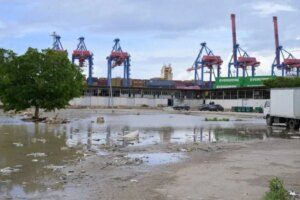
On the subject of food security, he pointed out that wheat and seeds have been the basis of monopoly since the Beirut port explosion and the transfer of storage to the private sector. He revealed the completion of a clear strategic study that will be presented within two weeks to the Council of Ministers on storage, its quality, locations, and financing, including the construction of new silos in Tripoli, Beirut, and the Bekaa next year, while emphasizing that the old silos are not threatened with collapse currently but need environmental treatment.
He pointed out the existence of a committee headed by him to follow up on keeping the silos as a memorial landmark for the victims of the Beirut explosion, provided that the geometric shape is studied and the site is transformed into a memorial space.