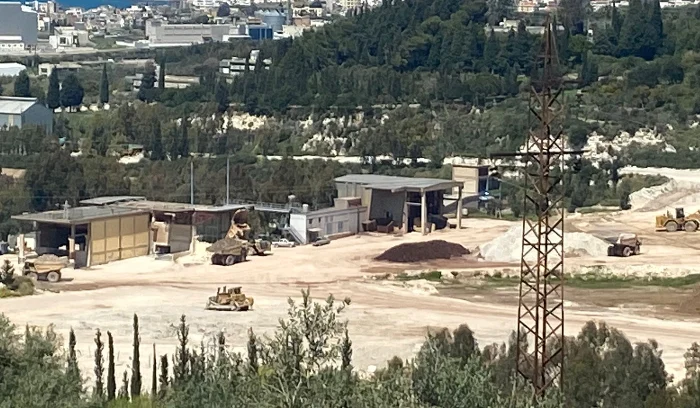
While whispers echo in the halls of Parliament about a looming “fait accompli” regarding the extension of the National Cement Company’s operations, quarry and crusher owners have expressed their refusal to approve the qualification and investment request, which Environment Minister Tamara El Zein included on the Cabinet’s agenda, despite its violation of the law.
Information obtained by indicates that the sub-ministerial committee tasked with studying this file presented, during a “stormy” meeting that witnessed some clashes with representatives of civil society organizations and some participants, a request from the cement company to extend its operations exceptionally for a year, in the absence of the Minister of Environment.
However, the information confirms that no final decision has been reached on this matter so far. In contrast, organizations and representatives of civil society are preparing to take action against any decision that this committee, especially the concerned ministers, may take in favor of the cement company, under the pretext of “protecting national industry.”
It is known that MP Najat Saliba has prepared a report on the paths followed by cement factories in Lebanon, in which she considered that they are “not ordinary legal procedures, but a repeated series of attempts to bypass applicable laws and circumvent the regulatory frameworks drawn by Decree No. 8803/2002, which regulates the work of quarries and crushers.”
The report, obtained by , stated that “the approach is the same and does not change: incomplete requests, repeated revisions, and continuous pressure to impose a fait accompli on municipalities, people, and the environment, and to obtain licenses exceptionally until the exception has practically become the rule. This model is clearly evident in the file of the National Cement Company during 2025, where the company sought, with remarkable persistence, to obtain qualification and investment licenses in Bdadoun and Kfarhazir, despite its file lacking the basic conditions required by law.”
The following is worth mentioning:
On June 4: The company submitted a request to the Ministry of Environment to obtain investment and qualification licenses in a number of properties.
On June 16: The file was re-audited for the second time, and it became clear again that there were fundamental shortcomings.
On July 4: The Ministry informed the company that these deficiencies must be completed in accordance with the procedures.
On July 10: The company submitted some additional documents, coinciding with the objections of residents from both towns.
On July 11: The residents of Kfarhazir submitted a signed petition to the Ministry of Environment expressing their categorical rejection of licensing the company, in addition to receiving an official letter from the mayor confirming the explicit municipal rejection.
Here, it must be recalled that Article 8 of Decree 8803/2002, which regulates quarries and crushers, stipulates that the decision of the competent municipal council, in case of non-approval, must be justified and binding; which means that the company’s insistence on pursuing the request constitutes a blatant disregard not only for the municipal council’s decision but also for the law that regulates the licensing mechanism.
Consequently, despite the clarity of the rules, the Ministry of Environment continued reviewing the file for the third time, ultimately rejecting the request on July 18. However, correspondence and meetings between the Director-General of the Environment and the company continued during the months of July and August, in direct violation of the mechanism imposed by Decree 8803.
MP Saliba says in her report that “On September 16, 2025, the Council of Ministers issued a decision obligating the National Council for Quarries and Crushers not to renew or grant any license to any company that has not paid its environmental, regulatory, financial, and tax dues in accordance with collection orders. Nevertheless, on September 26, the Director-General of the Environment sent a referral to the Minister of Environment, stating that the company had not been able to secure the required documents to date, proposing conditional approval of its request, which is a double violation of both Decree 8803 and the Council of Ministers’ decision.”
It is noted that on November 17, 2025, the National Council for Quarries and Crushers convened a meeting with a quorum and took a clear and decisive position: it rejected the National Cement Company’s requests for qualification and investment in Bdadoun and Kfarhazir, so the Ministry of Environment referred the file back to the Council of Ministers.
It is worth mentioning that Decree 8803 does not grant any political or administrative body the right to override the decision of the National Council for Quarries, but on the contrary, it holds it responsible for accepting or rejecting requests, monitoring compliance with conditions, and imposing measures in case of violation (Article 6), as well as imposing clear penalties on any investment without a license or in violation of the terms of the license, reaching imprisonment, fines, quarry closure, and obligating the investor to rehabilitate at his own expense (Articles 24 and 25).
Saliba confirms in her report that “all cement companies have been adopting the same approach for decades: seeking to bypass Decree 8803 and obtain a conditional or exceptional license as usual, under the slogan of meeting market needs and the pretext of economic public interest. The exception itself has become inconsistent with the conditions for protecting the health and basic rights of citizens, especially their right to live in a healthy environment. Considerations of meeting local market needs and economic and industrial growth cannot come at the expense of resource sustainability. Therefore, protecting natural resources and guaranteeing the right of Lebanese people to a healthy environment is not a luxury or an intellectual indulgence, but rather the basis of modern economic growth and the foundation of any rational policy that recognizes the limits of the land and its capacity to endure.”
As for the solutions, Saliba says that “it is not by slaughtering the mountains and continuing the chaos of quarries, but by adopting fair options that do not destroy villages or pollute the air, such as allowing the import of clinker and cement, and reducing customs duties on cement imports to ensure fair competition. This organized measure stops depletion and market monopolization, ensures transparent competition to meet local market needs, and prevents turning areas into victims of an economic model based on plundering resources and impunity.”
Saliba concludes by emphasizing that “the battle of Bdadoun and Kfarhazir is not a technical dispute over a quarry license, but a glaring example of how Koura and other regions are being turned into victims of an economic model based on plundering resources, destroying soil, water, and air, displacing their youth, and killing those who remain with cancer, heart disease, and chest diseases. Therefore, when the residents and the municipality abide by the law, and the Ministry of Environment and the National Council for Quarries fulfill their legal duties, and then the door is reopened to recycle the file and search for devious political and legal exits, we are facing a decisive moment: either the law is firmly applied and the villages and their people are protected, or the logic of impunity continues. Therefore, protecting Koura begins with stopping the chaos of quarries and crushers, and establishing the right of people to a healthy land, clean air, and unpolluted water, and that any compromise at the expense of the law, the environment, and public health is rejected.”