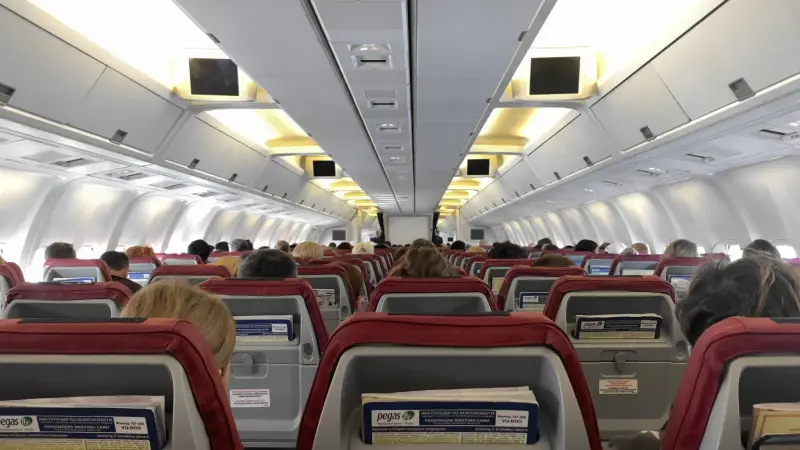
According to this research, the air inside airplanes and hospitals mainly contains harmless microorganisms, which are usually associated with human skin.
In a study considered the first of its kind, scientists used an unconventional method of sampling, which is face masks and aircraft air filters, to reveal the hidden world of microorganisms that live in indoor air.
The results showed that the same types of harmless bacteria associated with humans are dominant in the air of both airplanes and hospitals.
## Is indoor air polluted?
In all samples, the team discovered 407 different types of microorganisms, including common skin bacteria and microorganisms found in the environment. Although some microorganisms that may cause disease appeared, they were very few and there were no signs of active infection.
Erica Hartmann, from Northwestern University, who led the study, said:
* “We realized that face masks could be used as a cheap and easy tool to sample air from people and public exposures.”
* “We extracted DNA from those masks and examined the types of bacteria present in them.”
* “It was not surprising that the bacteria were of the types we usually associate with indoor air.”
## What do these results mean?
In an in-depth study, researchers found that hospital and airplane air contains a diverse, albeit mostly harmless, mixture of microorganisms, with only slight traces of potentially disease-causing species.
In both environments, common human-associated bacteria, especially those found on the skin and in indoor air, dominated the samples.
This similarity suggests that humans themselves, rather than the specific environment, are the main source of airborne microorganisms in both environments. And that the microorganisms in indoor air come from people’s skin, not from diseases.
Hartmann’s team also identified a number of antibiotic resistance genes, associated with major classes thereof.
Although these genes do not indicate the presence of dangerous microorganisms in the air, they highlight the pervasiveness of antibiotic resistance.
Hartmann said: “In this study, we only focused on what is in the air, but hand hygiene remains an effective way to prevent the spread of disease through surfaces.”