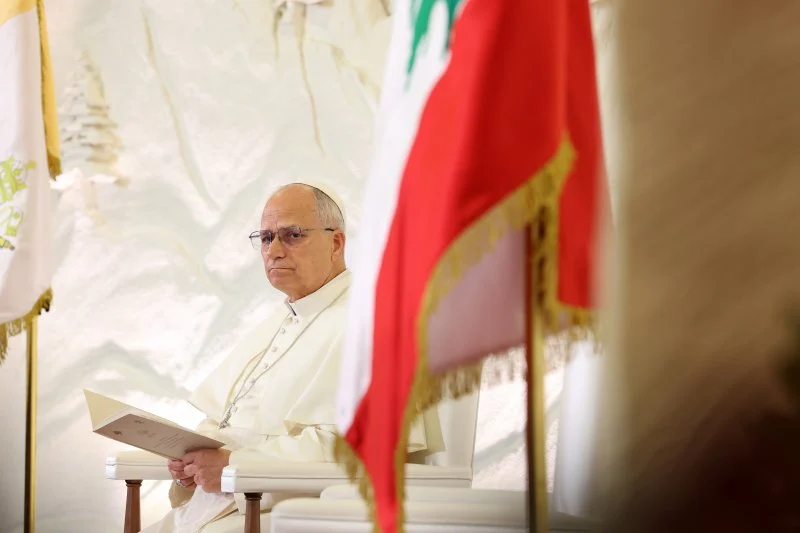
Pope Leo pointed out that the Lebanese people do not succumb to despair, but rather rise from the clutches of adversity, directing a message to them in which he said: “You are a people who do not give up, but rather a people who stand firm in the face of difficulties and know how to be born again.” He added: “You are a diverse country and a group made up of groups united by one language, which is the language of hope that has allowed you to start anew.”
He stressed that the steadfastness of the Lebanese is a prominent feature that cannot be ignored, noting that the pursuit of peace is a renewed and continuous beginning, and that commitment to it knows no fear in the face of repeated failures. He reiterated that Lebanon is a multicultural country, and that its unifying language is the language of hope, considering that it has the right to be proud of its “vibrant civil society rich in competencies.”
At the end of his speech, the Pope called on the Lebanese not to separate from their people and to dedicate their efforts to serving them, expressing his hope that they will always speak the language of hope so that they can start again as one nation.
Pope Leo XIV continued in another aspect of his speech that there are personal and collective wounds that need many years, and sometimes entire generations, to heal. He stressed that the truth only appears through communication and meeting, and that truth and reconciliation grow together.
He stressed that sustainable reconciliation cannot be achieved without a common goal, and without openness to a future in which good triumphs over evil, noting that a culture of reconciliation requires the authorities and institutions to recognize the provision of the public interest.
He affirmed that peace is not merely a fragile balance between individuals living under one roof but separated, but rather the ability to coexist together for a prosperous future, and then – as he mentioned – peace achieves that prosperity that amazes us when it transcends barriers and restrictions.
He pointed out that peacemakers have enough courage to stay and continue, even if it requires some sacrifices, adding that returning to the homeland requires determination and vision despite the harsh conditions, and that peace flourishes only in a vital and practical environment.
He said: “Christians and Muslims are called to play their true role by educating the international community.”
The Pope concluded by saying: “I renew my thanks to you once again for the warm reception, and I will always remember you in my prayers.”