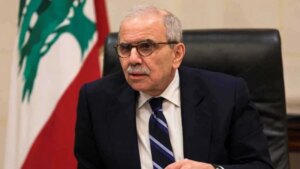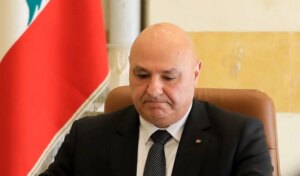
Minister Haidar began his tour by visiting the Al-Zahraa Complex, where he recited Al-Fatiha at the tombs of Sheikh Afif Al-Nabulsi and his son, the martyred journalist Muhammad Afif, and then met Sheikh Dr. Sadiq Al-Nabulsi, where the latest developments were presented.
After that, Haidar headed to the Jaafari Mufti’s office in Al-Bawaba Al-Fouqa, where he met Mufti Sheikh Muhammad Assiran. During the meeting, the minister stressed that “the rapprochement and unity of the Lebanese are the guarantee of Lebanon’s steadfastness in the face of the Israeli enemy and preventing it from achieving its goals.”
For his part, Sheikh Assiran spoke about “diversity and harmony in the region,” calling for its preservation, and stressing that “Israel is a source of corruption and depravity.”
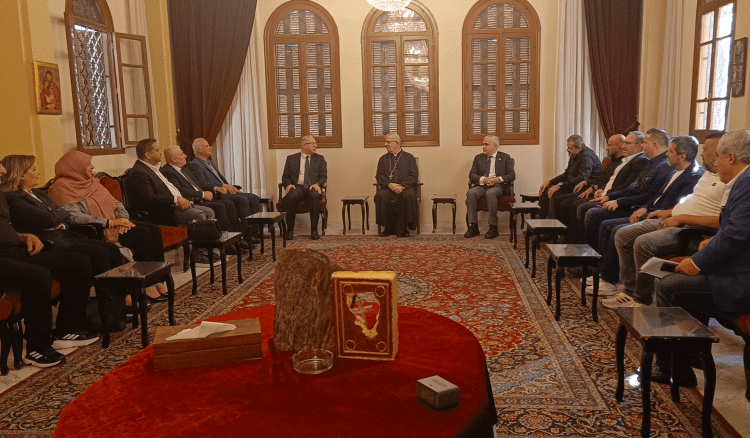
In the Nicholas Greek Orthodox Cathedral, Minister Haidar met Bishop Elias Kfoury, who presented “the suffering of the southerners as a result of the Israeli attacks,” pointing out that “the enemy does not differentiate between one sect and another,” and explaining that “the recent attack on Marjayoun was an insult to the Christian religion in its church.”
For his part, Minister Haidar affirmed “national unity and coexistence in the south and all of Lebanon,” noting that the government is working on reconstruction “as soon as possible” in the hope of reaching near solutions.
Minister Haidar continued his tour by visiting the Maronite Bishopric, where he was received by Bishop Maroun Al-Ammar, the head of the Union of Municipalities of Jezzine, Dr. Bassam Romanos, the mayor of Anqoun, Engineer Fouad Farhat, and the member of the municipal council, journalist Samar Haidar, where the general conditions were reviewed.
Bishop Al-Ammar praised “the fraternal interaction between the region’s activists,” stressing that the Bishopric is “an open house for everyone,” and offering his congratulations to the Lebanese on the occasion of Independence Day.
He added that the visit “expresses the meanings of preserving the independence of the homeland with its diversity and message,” stressing adherence to coexistence. He touched on the occasion of Independence Day in light of the Israeli attacks, considering that “Lebanon has many enemies, foremost among them is Israel,” and that “adherence to unity strengthens the national message.”
Later, Minister Haidar visited the Mufti of Sidon and its districts, Sheikh Salim Sawsan, at his home in Al-Salehiya, where Sawsan welcomed the minister at the beginning of his speech, stressing on Independence Day “the unity of the national ranks and the one life,” and that “the freedom of the country is the freedom of all.”
He hoped that the next stage would bring “more sense of dignity and sovereignty.”
For his part, Minister Haidar thanked Mufti Sawsan for his reception, noting that the meeting was an opportunity to discuss people’s affairs and the Mufti’s role in strengthening national unity. He stressed that “the concern of the Lebanese worker is the main concern,” and the effort made to find job opportunities and improve the retirement and social protection system.
He pointed out that work is underway to secure “a decent minimum for the worker despite the economic difficulties.” He saluted “the martyrs of independence,” considering that independence today is “incomplete with the presence of the Israeli enemy.” He also mentioned the fall of martyrs in the Ain al-Hilweh camp as a result of the recent Israeli attack, stressing that “the project aimed at stirring up division will not pass,” and that internal unity “constitutes an impenetrable barrier in the face of the enemy’s plans.”
Minister Haidar concluded his tour by visiting Dar Al-Inaya in Al-Salehiya, where he was received by the head of the Dar, Father Matanios Haddad, in the presence of Dr. Bassam Romanos. During the meeting, views were exchanged on the general situation, and the minister listened to a presentation on the Dar’s activities, especially those implemented during the period of the Israeli aggression and the reception of the displaced southerners.
Minister Haidar expressed his appreciation for the efforts made by the Dar in serving the displaced, announcing the ministry’s readiness “to cooperate with it in various fields.”