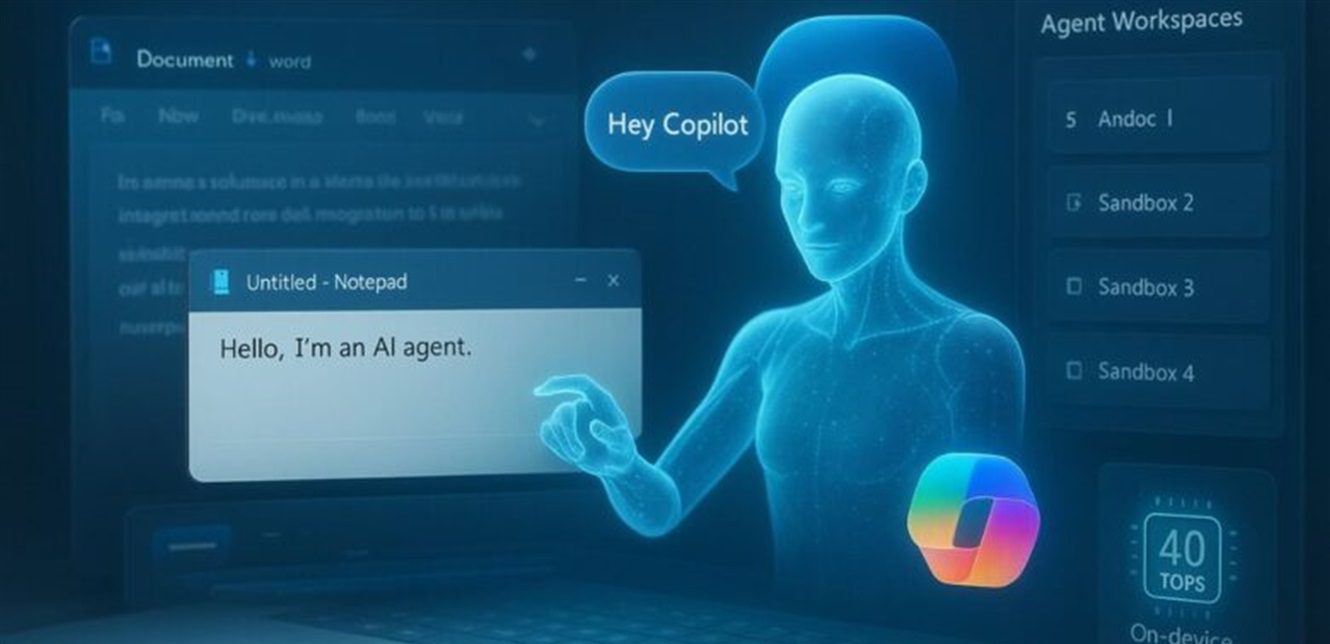
The company aims to transform the system into an “AI canvas,” allowing users to use smart agents capable of performing complex tasks and managing the device in the background with the click of a button.
Artificial intelligence agents are intelligent systems that perform tasks on behalf of the user independently, rather than just providing answers. They are characterized by working in the background, making decisions, and interacting with applications and files, allowing them to automate repetitive and complex tasks.
Navjot Virk, Corporate Vice President of Windows Experiences, says the goal is to “provide every user with super-powered AI capabilities.” These agents – whether from Microsoft or third-party developers – will allow operations such as searching for data, navigating files, and automating tedious office tasks to be performed without direct intervention. The agents’ activity will appear in the taskbar as they work in the background, with a floating window to interact with or follow progress.
This move comes as part of the new Ask Copilot feature, which combines local search with the capabilities of Microsoft’s Copilot AI assistant. The user can start a direct conversation from the taskbar or automatically run an agent to perform a specific task. Agent icons display visual notifications of the task status, such as a yellow warning sign when intervention is needed, or a green sign when the work is completed.
Microsoft confirms that these features are completely optional, as the appearance of agents in the taskbar can be disabled. The company is also working to provide a unified framework for agents through the Model Context Protocol, which allows agents to explore and interact with tools safely, while providing a dedicated operating space similar to a sandbox with a separate account for each agent to protect the user’s primary session.
The extensive update includes integrating Copilot assistant into the File Explorer application, allowing summarizing documents, answering questions, and creating drafts of messages based on file content with one click. Copilot Plus computer users will also receive improvements to the Click to Do feature, which allows any table on the web to be converted into an editable Excel file, combining local and cloud AI models.
New features include enhanced writing tools that work in any text box within Windows with offline support, along with providing AI-powered summaries in Outlook and automatic alternative text for images in Word, in addition to a “seamless” voice dictation feature that produces accurate texts with correct grammar.
With these updates, Microsoft opens the door to a new generation of personal computing in which the system merges with artificial intelligence to work proactively and more integrated with user needs, but some users express broad concerns about these updates.
Microsoft faces a storm of criticism
Microsoft’s recent announcement of its aspiration to transform Windows into an “Agentic OS” sparked a wave of opposition, as some users see this move as an attempt to impose unwanted artificial intelligence tools and increase reliance on cloud features without clear options to disable them.
Criticism spread across social media, with users expressing concern that these features would be automatically imposed on all Windows devices, and even on users who prefer simple, uncomplicated experiences. Many considered that the increased focus on artificial intelligence comes at the expense of full control over the system, warning that these complex new features may disrupt the traditional workflow.
Concerns also included the possibility of disrupting basic operations of office programs, such as editing documents and managing tables, if artificial intelligence tools are imposed without clear disabling mechanisms.
In light of these criticisms, some experts believe that the concept of an “agentic system” may be useful for large companies seeking deeper integration between artificial intelligence and device management and cloud infrastructure. These capabilities may constitute a real addition to companies that manage complex operations and rely on significant improvements in productivity.