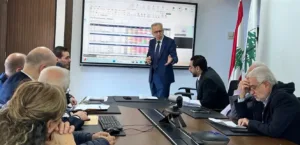
Jaber explained that “This meeting of ours is taking place at a very delicate time for our region, where security and political challenges intersect with increasing financial and economic pressures, accompanied by urgent social demands and renewed development needs.” He added that Lebanon, less than a year before this meeting, was facing the consequences of a devastating regional war that caused heavy losses in lives and property, and increased the fragility of economies and societies.
He pointed out that the region has suffered for decades from chronic fluctuations and unstable environments, which have hindered the ability to strategic long-term planning, and pushed public policies to a pattern closer to crisis management than to vision-making. He continued: “Very often our financial priorities were drawn under the pressure of security emergencies and immediate challenges, not in an atmosphere of stability that allows for sustainable planning. But our meeting today in Beirut carries a clear message of hope: that our region is capable of rising from crises towards a new social contract, based on restoring the citizen’s confidence in state institutions and their ability to manage public funds fairly, efficiently and transparently.”
He stressed that “The challenge that brings us together in this forum is how to enhance the credibility and effectiveness of financial policies, as a pillar of confidence in public action.” He added: “Experience has proven that development can only be built on good public finance management, and that the budget is not just an accounting tool for allocating credits or controlling expenditures, but it is a mirror of society’s priorities and an embodiment of its aspirations.” He pointed out that “What is required is to achieve a delicate balance between the needs of today and the responsibilities of tomorrow – between the immediate response to social pressures, and maintaining financial stability and ensuring the sustainability of public debt.” He stressed “The importance of improving the targeting of social spending, directing resources towards productive sectors, and investing in human capital, as essential pillars for building more resilient, equitable and growing economies.” He affirmed that “This challenge is not only technical, but it is a moral and national responsibility that transcends generations, because we are shaping the features of our children’s future today. And in the language of public finance, this responsibility is summarized in one concept: sustainability.”
He pointed out that “The budget is at the heart of the social contract, and for this reason, the topics of this forum are of exceptional importance.” He expressed his hope for “A fruitful dialogue and exchange of experiences and successful expertise among our sister countries, to benefit from the best regional and international practices in budget preparation, public finance reform, and the promotion of the principles of transparency and accountability.”
Jaber expressed his hope that “This forum will be a practical step towards consolidating Arab cooperation in this vital field, and laying solid financial and economic foundations that contribute to building a more stable and prosperous future for all our peoples.”
In concluding his speech, Jaber extended “His sincere thanks to ESCWA and UNICEF for their continuous support for this initiative, and to all participating delegations for their attendance and commitment to the spirit of cooperation and joint action,” wishing the forum every success, and his Arab region continued security and prosperity.