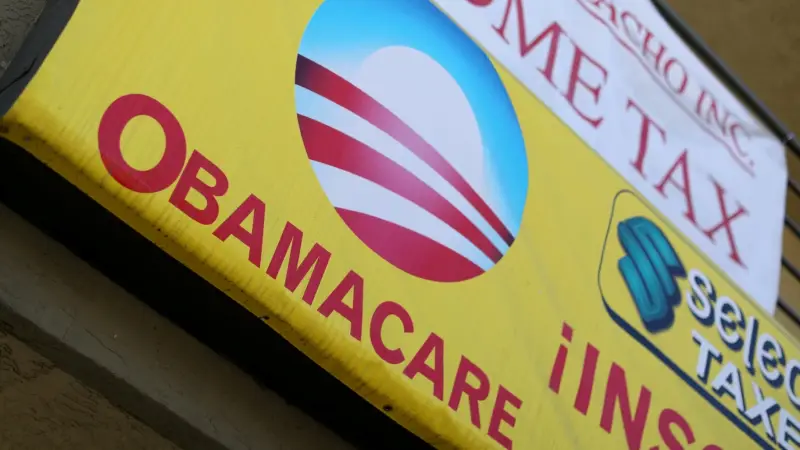
U.S. President Donald Trump has proposed redirecting federal funds allocated to health insurance companies under the Affordable Care Act “Obamacare” and giving them directly to individuals, amid the ongoing government shutdown in the United States.
Trump’s New Plan
Many Republicans have indicated that “providing health care subsidies in cash to consumers would give Americans more control over their expenses.” While opponents of Trump’s plan believe that “this could severely undermine ACA markets,” according to an analysis by “Politico.”
Republicans are adopting a different approach to supporting healthcare for Americans, which involves directing funds away from insurance companies and placing them directly in the hands of consumers, giving them greater freedom to choose the coverage that suits them.
Economists and political experts believe that President Donald Trump and members of the Republican Party in Congress are proposing this alternative to extend the enhanced Affordable Care Act subsidies “Obamacare” in order to undermine or replace the program, which the party has failed to achieve in the past.
Health Care Plans
Larry Levitt, Executive Vice President for Health Policy at the “KFF” Foundation, a non-partisan research organization, stated that “through direct cash payments from the federal government to private accounts, healthier people can get much cheaper insurance that includes medical insurance and does not cover pre-existing conditions, but this would leave the sickest people in the Affordable Care Act pool, and that would likely lead them to death.”
Levitt and others added that “if younger, healthier consumers choose so-called junk health care plans, with low costs and less robust coverage, and if they don’t use the money for health insurance, it could lead to an imbalance of risk and push insurance companies out of the market entirely.”
Republican proposals regarding direct payments still lack basic details, and include creating health savings accounts or flexible spending accounts for millions of Americans, and depositing cash funds into them instead of providing enhanced premium support that goes directly to health insurance companies.
“Obamacare” Subsidies
Republicans have long favored such accounts, but they are currently gaining momentum as the Republican Party looks for alternatives to extend enhanced “Obamacare” subsidies, a key demand from Democrats in the government shutdown battle.
Trump expressed his support for this concept over the weekend, when he said in a post on “Truth Social” that “the hundreds of billions of dollars that are currently being sent to insurance companies that are sucking up the money should be sent to the people.”
Bill Cassidy (Republican from Louisiana) suggested redirecting enhanced support funding to pre-tax flexible spending accounts, which, unlike health savings accounts, should be exhausted within a specified period of time, for Americans to use to cover health care expenses such as deductibles or co-payments. He pointed out that “the talks are still in their early stages,” expressing his hope that the Democrats would listen in good faith.
He told reporters: “This is the kind of American policy that looks like it’s targeting the patient and the consumer that we ought to be able to agree on on a bipartisan basis, and it seems unlikely that Democrats will be convinced of that.”
Extending Tax Waivers
For his part, Senator Chris Murphy (Democrat from Connecticut) said: “We will not reach this deal during open enrollment. The only option now is to extend the subsidy for a year.”
As part of the bipartisan agreement to reopen the government, Republicans promised Democrats a Senate vote in December on legislation to extend expiring tax waivers, which helped drive record enrollment in “Obamacare” since Democrats created the subsidies in 2021.
The enhanced tax waivers that help low- and middle-income Americans pay for “Obamacare” premiums were extended in the Inflation Reduction Act, which President Joe Biden signed into law in 2022.