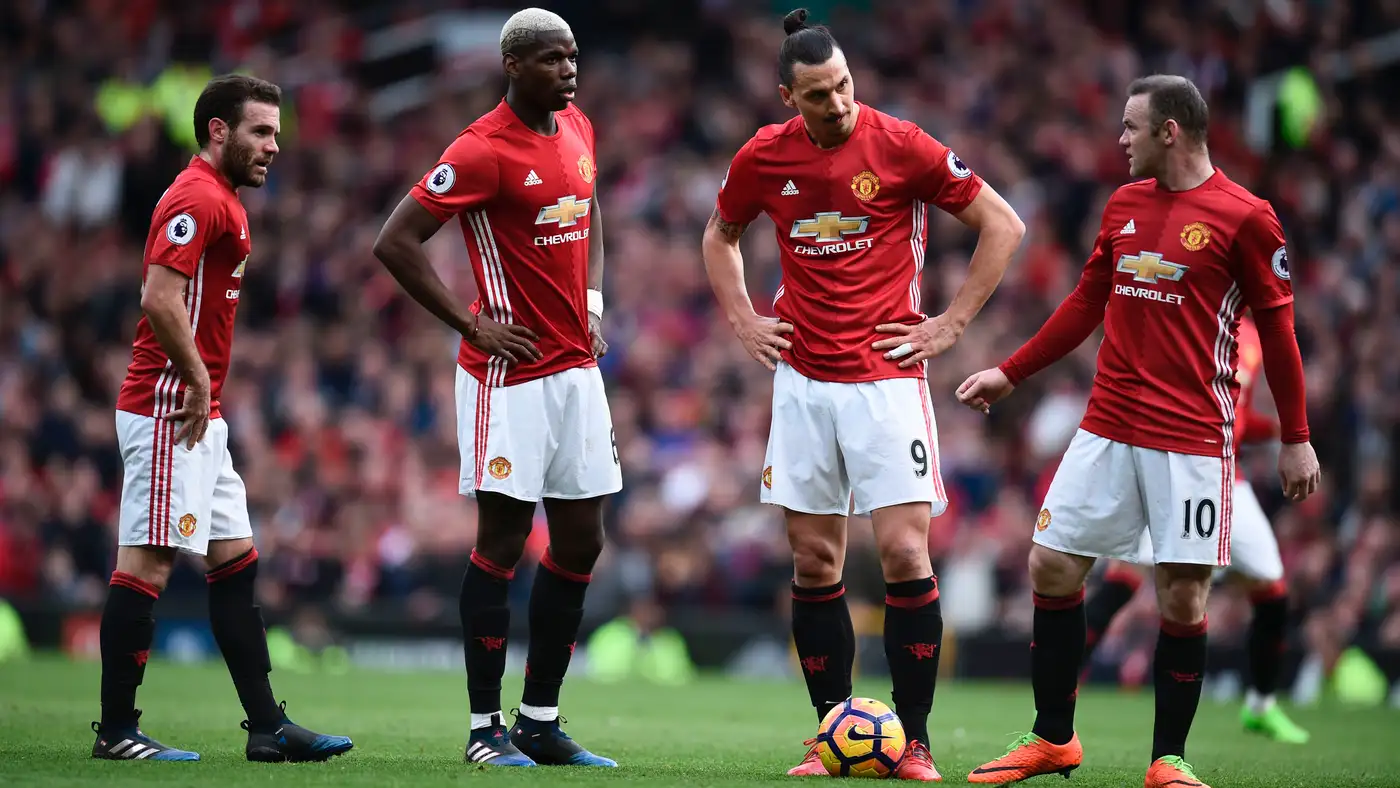
Wayne Rooney, the former Manchester United star, believes that the team is still suffering from the consequences of deals made before the arrival of Sir Jim Ratcliffe, most notably the deals for Romelu Lukaku, Zlatan Ibrahimović, and Paul Pogba, which he believes have harmed the club.
Rooney said in statements on a podcast on the “Sky” network: “The deals that Manchester United made before last summer were disastrous.”
He added: “The club brought in big names like Lukaku, Zlatan, and Pogba, they were good players, but the idea was just to attract bright names for huge sums.”
He added: “The club will need some time to overcome these mistakes.”
Rooney believes that there has been a marked improvement in the team’s performance recently under the leadership of coach Ruben Amorim, saying: “If you look at Manchester United over the past ten years, you will see that the players were under tremendous pressure.”
He continued: “Now, after achieving some good results, confidence has begun to return to them.”
He added: “This even applies to the coach. There is a gradual and tangible improvement.”
He completed: “It was very difficult for Ruben Amorim, and I criticized him severely, but we are witnessing a development in their level, and the players have become more harmonious.”
He concluded: “There are positive indicators, and although they will not win the league, they may be able to finish the season in the top four.”
Ratcliffe’s Era
About two years ago, British billionaire Jim Ratcliffe made a major change in the football management at Manchester United when he and his company INEOS acquired 25% of the club’s shares from the Glazer family. This move marked the beginning of a new era in the history of the “Red Devils”.
This deal was not just a financial transaction, but a turning point in the way football is managed in one of the largest clubs in the world.
Before Ratcliffe, Ed Woodward, the executive vice-chairman from 2012 to 2021, was in charge of football affairs.
Despite the club achieving significant commercial successes during this period, the sporting performance was not up to par, as coaches came and went and deals failed to return the team to its accustomed place at the top of English and European football.
Ratcliffe, known for his industrial expertise and ability to manage large projects through his “INEOS” empire, entered the club with a different mentality focused on complete sporting professionalism rather than marketing considerations.
He focused on rebuilding the club’s sporting structure from the ground up, by appointing technical staff specialized in analysis, talent scouting, and performance management, with the aim of returning United to the circle of real competition.
Ratcliffe seeks to implement a philosophy based on sustainability and long-term planning, drawing on his experience in managing other teams such as Nice of France and Lausanne of Switzerland.
His clear goal is to transform Manchester United into an integrated institution that combines sporting success and financial stability, away from the randomness that characterized the post-Sir Alex Ferguson era.
While the results are still being investigated, Ratcliffe’s influence is evident in the club’s culture and daily decisions, and fans are looking forward to this stage being the end of years of turmoil, and the beginning of a real return for Manchester United to its place among the giants of Europe.
Beginnings of Improvement
Manchester United has witnessed a marked improvement in results during the recent weeks of the English Premier League, after a period of fluctuation at the beginning of the season.
This improvement is mainly due to the summer deals that gave the team greater depth and diversity in attacking options, in addition to renewing confidence in coach Ruben Amorim, who has begun to clearly leave his tactical mark.
After a modest start to the team, and its decline to the middle of the table, it began to achieve a series of positive results, which gradually improved its ranking and returned it to the circle of competition for the places qualifying for European championships.
Amorim’s influence was evident in defensive discipline and organizing collective pressure, in addition to restoring balance in midfield thanks to some adjustments to the players’ positions.
Also, the new duo, Matheus Cunha and Bryan Mbeumo, contributed to improving offensive effectiveness, and the team returned to scoring regularly after a long struggle in front of the goal.
Renewing confidence in Amorim proved to be the right decision by the club’s management, as the Portuguese coach showed his ability to manage the dressing room intelligently, and restore the competitive spirit that had been absent from the team in previous seasons. Fans now feel that there is a clear project aimed at building a team capable of continuity, and not just a reaction after every setback.
Today, with Manchester United’s improved position in the league table and the high morale within the team, it seems that the club has begun to gradually regain its balance, and is seeking to return to the top four, with the aim of returning to the Champions League and restoring the “Red Devils” status at the local and continental levels.