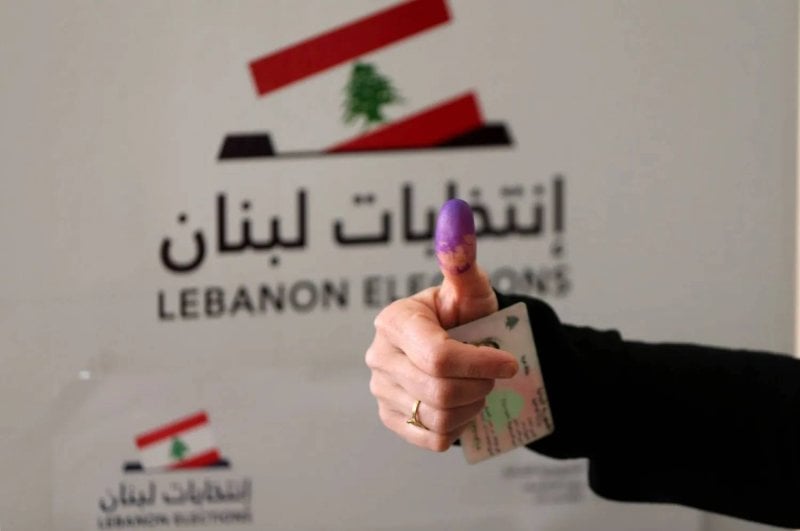
The newspaper believes that the upcoming parliamentary elections in May will be “a crucial test of the Lebanese people’s will to restore their national decision,” after years of economic collapse, political corruption, and the party’s dominance over the state.
“The Hill” emphasizes the importance of the right to vote for Lebanese expatriates, who have strong economic, social, and political ties to their homeland.
According to the 2017 election law, only six seats out of 128 were allocated to expatriates, which the newspaper considers an attempt to reduce their political influence.
It pointed out that this restriction was temporarily suspended in the 2018 and 2022 elections, but it will return to effect in the 2026 elections if the law is not amended, which will limit the representation of expatriates to only six deputies.
The newspaper explained that the votes of Lebanese expatriates have become influential in the political scene, as about 140,000 expatriates participated in the 2022 elections, equivalent to 7% of the total voters, and a large percentage of them voted for independent and reform candidates at the expense of candidates allied with “Hezbollah.”
The newspaper confirms: “The expatriate vote has become a strategic balance capable of shaking Hezbollah’s dominance.”
“The Hill” revealed the failure of an attempt to amend the law last June, after the Speaker of Parliament, Nabih Berri, refused to include the issue on the agenda, which the newspaper considered evidence of the traditional forces’ fear of losing their power.
It added that “Hezbollah” and the Amal movement know very well that the majority of expatriates tend to support independent and opposition candidates, so they adhere to electoral restrictions to maintain the status quo.
In a related context, a report by “Alhurra” channel shed light on the economic deterioration of “Hezbollah,” pointing to the escalating dispute between it and the Lebanese state institutions due to the tightening of control over financial transfers and smuggling operations.
The channel stated that the Secretary-General of “Hezbollah,” Sheikh Naim Qassem, attacked the Governor of the Bank of Lebanon and the Minister of Justice, accusing them of “implementing foreign instructions aimed at suffocating the economic base of the resistance,” stressing that “the Governor is not an employee of America, nor is the Minister affiliated with Israel.”
According to “Alhurra,” these statements reflect the extent of the dispute between the party and the official authorities, which are facing increasing international pressure to implement sanctions on individuals and entities associated with the party.
The channel pointed out that the United States and its regional partners have been following a “silent war strategy” against “Hezbollah” for years, based on isolating it economically and drying up its sources of funding instead of direct military confrontation.
“Alhurra” recalled that the administration of former US President Donald Trump expanded the “maximum pressure” policy on Iran and its allies, as the US Treasury Department imposed sanctions on seven officials associated with the “Al-Qard Al-Hasan” institution, the party’s financial arm, and “Jamal Trust” Bank, which was accused of dealing with institutions affiliated with the party, was closed.
The US Congress also approved laws allowing the punishment of Lebanese banks that cooperate with entities listed on terrorism lists.
According to data نقلت عن وزارة الخزانة الكندية, “translated: quoted from the Canadian Ministry of Finance” , “Hezbollah’s” annual revenues are estimated at about one billion dollars, sourced from Iranian support, commercial investments, and illegal activities such as drug trafficking and digital currencies.
The channel added that the party is active in international smuggling networks extending from the Mediterranean Sea to Latin America.
Inside Lebanon, the report indicated that economic pressures have led to a sharp decline in the party’s financial capabilities, which has forced it to reduce its social spending and service projects that were a mainstay of its popular influence.
The Lebanese authorities also tightened monitoring measures at ports and border crossings, prevented Iranian planes from landing, and arrested a number of government employees on charges of association with institutions affiliated with the party.
Last September, the Bank of Lebanon issued Circular No. 170, which prohibits financial institutions from dealing with entities subject to international sanctions, including associations linked to the party, while Minister of Justice Adel Nasser issued a decision prohibiting notaries public from documenting any deals pertaining to individuals or entities listed on these lists.
Economic expert Khaled Abu Shaqra believes that these steps aim to avoid isolating Lebanon financially more than it already is, after it was included on the “gray list” of the Financial Action Task Force (FATF), explaining that the application of international standards is necessary to restore confidence in banks, but the authority of the central bank is limited because dismantling the networks linked to the party requires complex judicial procedures.
For her part, researcher Muhassen Mursal, who specializes in combating financial crimes, said that the party is increasingly relying on what she calls the “black economy,” which is based on tax evasion, smuggling, and informal transfers, at a time when the state has barely begun to pursue these files.
The report concluded by pointing out that “the combination of declining Iranian support and tightening international sanctions has put Hezbollah in a real existential predicament,” as the party finds itself forced to reduce its internal activities and hold the state responsible for the crisis, in an attempt to portray it as a government failure, not as a direct result of the decline in its economic and political influence.