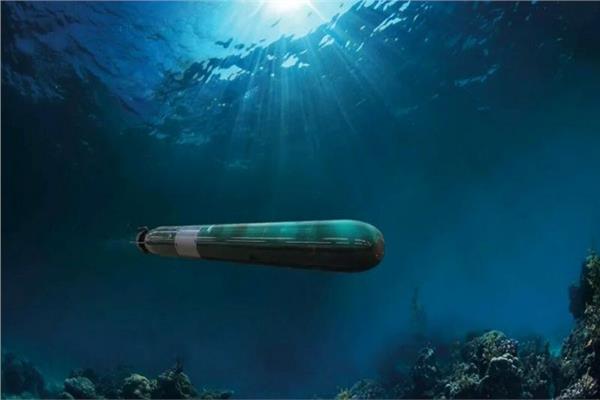
Russian reports indicate that detonating this underwater nuclear torpedo could lead to the formation of tsunami waves as high as 500 meters, threatening to flood coastal cities, industrial facilities, and naval bases surrounding the point of explosion.
The warhead carried by the Poseidon torpedo is believed to have the ability to destroy vast areas with radiation, as it is supposedly equipped with a cobalt bomb that doubles the long-term radioactive effect.
Poseidon is defined as a small, autonomous submarine, similar in design to a giant torpedo, capable of traveling distances of up to 10,000 kilometers at a maximum speed of 200 kilometers per hour, and diving to a depth of 1,000 meters below sea level.
The weapon relies on an advanced nuclear propulsion system that allows it to cruise for weeks without refueling, as well as advanced acoustic stealth technology that enables it to overcome sonar and thermal detection systems.
Its main advantage is cruising at low speed while heading towards the target to avoid detection, then activating its maximum speed in the final stage of the attack (2 to 3 kilometers from the target), making interception or disabling it difficult.
Poseidon was first unveiled in 2015 and is designed to be an intercontinental nuclear torpedo capable of carrying a 2-megaton warhead. It is about 24 meters long and can navigate autonomously at speeds of up to 107 knots.
According to Russian media, its purpose is to detonate near enemy coastal cities to create a devastating artificial tsunami wave.
Furthermore, the torpedo is capable of penetrating any anti-submarine barriers or naval defense systems thanks to a fully automated operating system that allows it to operate without direct human intervention.
The first submarine specifically designed to carry these torpedoes, the Belgorod, was launched on April 23, 2019, and is capable of carrying six Poseidon torpedoes at a time.
The weapon is named after the god of the sea in ancient Greek mythology, Poseidon, who was considered the protector of sailors and the master of storms and earthquakes.
According to legends, Poseidon was able to calm or stir up the seas and was nicknamed the “Earth-Shaker” because of his destructive power.
Observers believe that the choice of this name reflects the nature of the Russian weapon, which combines nuclear power and maritime rage, in a symbolic message to Moscow’s adversaries.