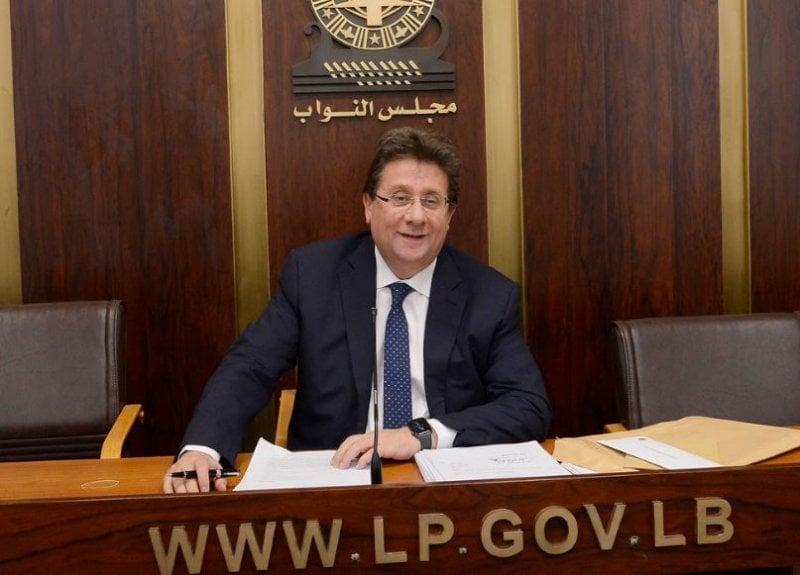
This meeting was devoted to discussing the latest developments related to draft laws and plans currently proposed, which aim to find solutions to recover deposits. Emphasis was also placed on the pivotal role played by the Finance and Budget Committee in approving any laws or plans submitted by the government regarding these deposits.
The meeting witnessed a frank and in-depth discussion, as members of the Union’s administration posed a series of questions and inquiries to MP Kanaan, in order to obtain clarifications regarding the various deposit recovery plans.
Among the topics discussed were the opinion and position of the MP, in his capacity as Chairman of the Finance and Budget Committee, regarding the government’s plans to classify deposits as “eligible and non-eligible,” the possibility of writing off a large portion of the deposits that were converted to dollars after October 17, 2019, in addition to the issue of bonds, the $100,000 plan, and other related issues.
MP Kanaan affirmed his categorical rejection of what is “called eligible deposits and non-eligible deposits before and after October 17, and his rejection of writing off any part of the deposits that were converted to dollars after October 17, 2019, and any write-off of this kind, or classification of deposits on the basis of eligible and non-eligible is an illegal act that violates the constitution, the law, and all prevailing norms.”
Regarding the “Financial Gap” law being prepared by the government and the Banque du Liban, MP Kanaan explained that “he was the one who invented the idea of the financial gap law since 2022 in the Finance and Budget Committee, and the goal of that is to recover deposits, not write them off.”
He also affirmed that “everything that is being circulated regarding the aforementioned law is just talk and statements in the media, and that the Finance and Budget Committee has not received any draft yet, and when the Committee receives the draft law from the government, it will be discussed and observations and the appropriate opinion will be expressed on it, and any clauses that include writing off any part of the legal and legitimate deposits or any clauses that classify deposits on the basis of eligible and non-eligible will be rejected.”
In a related context on the issue of bonds, Kanaan explained that “the issue of bonds is not as it is presented in the media, and if there are bonds, they may be bonds guaranteed by the Banque du Liban for the full value of the deposit, as he affirmed his rejection of writing off any reasonable and legal interest on deposits.”
He pointed out that “solving the issue of deposits must be limited to three parties (the state, the Banque du Liban, and the banks),” stressing that “the financial gap law could be returned to Parliament within a month or two.”
He also drew attention to the fact that “the Finance and Budget Committee is the only committee that approved the capital control law submitted by him since 2020 at the beginning of the deposit crisis, but the law was not adopted in Parliament.”
MP Kanaan expressed his cautious optimism, saying that he “sees a glimmer of hope for a comprehensive solution and that the coming year may lay the foundation for a financial and monetary solution in Lebanon.”
At the conclusion of the meeting, it was agreed between the two parties to continue close cooperation and coordination between MP Kanaan and the Union of Lebanese Expatriate Depositors, in all matters related to these sensitive issues.