Lebanon Today
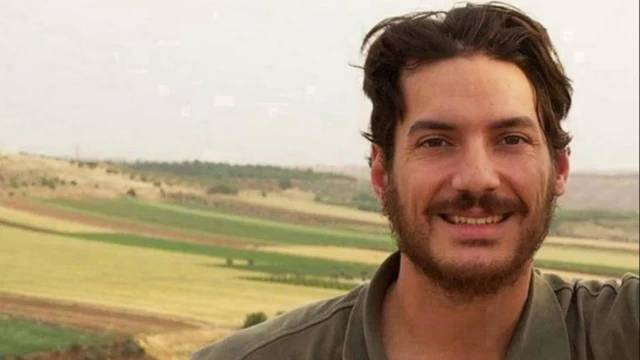
“CNN” correspondents Clarissa Ward and Sara Sirgany revealed new data and testimonies regarding the disappearance of American journalist Austin Tice in Syria in 2012.
Among these testimonies are accounts indicating that a prominent advisor to former Syrian President Bashar al-Assad, Bassam al-Hassan, claimed that al-Assad ordered Tice’s execution.
This investigation coincides with an American field operation led by the Federal Bureau of Investigation (“FBI”) in Damascus during September 2025.
In contrast, Tice’s family continues to deny the news of his death, asserting that he “is still alive.”
A guard at a military site located at the foot of Mount Qasioun in Damascus reported that “the Americans passed by here in their armored vehicles.”
“CNN” confirms that an American team arrived in the area in an armored convoy in early September, focusing its search on facilities associated with the “Syrian Scientific Studies and Research Center.” The operation lasted less than three days, after which the delegation withdrew hastily following an Israeli missile attack on September 9.
“CNN” clarifies that the information leading to the American move came from several witnesses, including Bassam al-Hassan, the former advisor to al-Assad, who confirms that Tice was being held after his arrest in mid-August 2012.
During a secretly recorded meeting in Beirut in September, al-Hassan said: “Certainly, Austin is dead,” and indicated that the killing took place in 2013, claiming he had informed one of his subordinates of the execution order.
However, the network reports from informed sources that al-Hassan failed the FBI’s lie detector test.
Other witnesses also described his account as flawed, emphasizing his “cunning” nature and unclear motives, especially with Washington announcing a reward of $10 million for any information leading to Tice.
Testimonies from former Syrian officers, including Major General Safwan Bahloul (Foreign Intelligence), state that Tice was held in a Republican Guard compound known as “Al-Tahnouna” near Qasioun, under the supervision of officer Ghassan Nassour, who reported to al-Hassan.
According to these testimonies, Tice was interrogated three times and was “cooperative” and “not confused.”
Bahloul recounts that Tice later escaped from “Al-Tahnouna” using soap and a towel to get past a high window and sharp wires on the compound wall, before being re-arrested more than 24 hours later in the vicinity of the Al-Mazza neighborhood.
After that, he was transferred to al-Hassan’s office opposite the complex, and “his news was cut off,” according to converging accounts.
Nassour confirms that soldiers from the regime forces wore “jihadist” clothing and took Tice, blindfolded, to a hill in the Rakhleh area near the Lebanese border to film the famous 46-second clip (September 2012) with the aim of suggesting that he was in the hands of extremist groups, not the regime.
American officials and independent analysts had previously considered the clip a “hoax,” and investigators tracked a digital trail leading to regime devices.
Since the fall of the al-Assad regime in December 2024, “CNN” says that the new Syrian government is working to improve relations with the United States and has cooperated with FBI investigators on the ground.
A source familiar with the investigation confirms that “the federal investigation is active, and the goal is to achieve some justice, in parallel with any possible recovery operation.”
In contrast, Tice’s family, especially his mother Debra, insists that he is “alive,” and she visited Damascus after the political change and met with the new Syrian President Ahmed al-Shara, renewing her demand for his return alive.
Testimonies from former Syrian officers state that al-Assad saw Tice as a valuable “bargaining chip” with Washington.
However, others suggest that the execution order was issued after Tice’s escape from “Al-Tahnouna.” Between 2012 and 2024, intermediary sources, including retired Lebanese Major General Abbas Ibrahim, say that successive American administrations made several offers for his release, but the Syrian negotiators refused even to provide a recent “proof of life,” which reinforced the suspicion that “the Tice card no longer exists.”
Accounts from witnesses and former officials agree on the existence of contradictory threads in a file characterized by ambiguity for more than 13 years.
Bassam al-Hassan’s account directly accuses al-Assad, but it suffers from credibility tests, while other intersections indicate the possibility that Tice was killed a long time ago, without conclusive evidence so far. Until the facts are revealed in official archives and secret graves, the family remains clinging to hope for life, the FBI to its criminal path, and the new Syrian government to trying to close one of the most ambiguous files of the past decade.
source: 961 today