Lebanon Today
Palestinian Prime Minister Dr. Mohammed Mustafa believes that the ceasefire agreement in Gaza and the “New York Declaration” on the two-state solution, led by Saudi Arabia and France, represent parallel tracks that converge on one goal, which is achieving the Palestinian state on the ground and recognizing it.
In a press interview conducted in Riyadh, Mustafa emphasized the importance of the ceasefire, but stressed that it is not enough. The most important thing is to activate the decisions of the “New York Declaration,” which represents a practical framework for international recognition of Palestine within 18 months.
He pointed out that some countries stipulated a ceasefire in Gaza for recognition of the Palestinian state, stressing that the Palestinian Authority is the primary party authorized to manage the affairs of the sector in the coming stage.
Mustafa reported that Riyadh recently hosted the high-level coordination meeting of the Global Coalition for the Implementation of the Two-State Solution, chaired by Saudi Arabia, Norway, and the European Union, with the participation of representatives from 35 countries, stressing that this meeting is the first of its kind to follow up on the implementation of the provisions of the “New York Declaration.”
He affirmed that Saudi Arabia and France are keen to continue working diligently to transform political promises into tangible practical steps.
Mustafa explained that the annex to the “New York Declaration” includes an implementation plan that extends for 18 months, and includes political, legal, and economic steps, including mutual recognitions, the reconstruction of Gaza, the unification of the West Bank and the Gaza Strip, the arrangement of Israeli withdrawal, and the establishment of a new economic relationship that contributes to reviving the Palestinian economy.
He pointed out that some countries, such as Denmark and Japan, still stipulate a ceasefire before recognizing the Palestinian state, expressing his hope that these positions will change after the implementation of the provisions of the declaration.
Regarding the return of the Palestinian Authority to Gaza, Mustafa explained that work is underway on several axes to gradually enhance the Authority’s presence, and revealed the formation of a government operations room in Ramallah for daily coordination with employees in the sector representing ministries and official bodies.
He also pointed to the formation of a community support committee that emerged from the decisions of the Arab and Islamic summits in Riyadh, to temporarily coordinate services and management until the government is fully enabled in Gaza.
The Palestinian Prime Minister revealed the readiness to cooperate with an international force established by the Security Council at the request of the State of Palestine, in order to support Palestinian security and secure the borders, noting that there is an agreement with Egypt and Jordan to train Palestinian security forces.
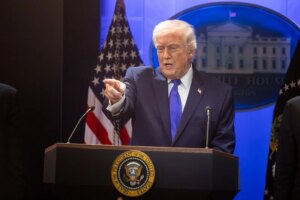
In contrast, he saw that Israel objects to the role of the Palestinian Authority because it seeks to maintain the separation between Gaza and the West Bank to prevent the establishment of a Palestinian state, pointing out that international and Arab parties, led by the United States under President Donald Trump, prevented Israeli attempts to annex the West Bank.
Mustafa spoke about a comprehensive institutional and political reform program consisting of 30 items, which began more than a year ago, and was presented to the European Union and the World Bank and received support from Saudi Foreign Minister Prince Faisal bin Farhan.
On the political side, he pointed to President Mahmoud Abbas’ announcement of presidential and legislative elections within a year of the ceasefire being established, in addition to establishing a committee to draft a new constitution, and laws for parties and local elections.
Mustafa confirmed that Israel is withholding more than $3 billion of clearance funds, and has not transferred any amounts for 6 months, which hinders the payment of salaries and the provision of services.
He explained that the United States, the European Union, France, Germany, Britain, and Spain are exerting pressure to release these funds.
Mustafa praised Saudi Arabia’s invitation to participate in the “Future Investment Initiative” conference in Riyadh between October 27 and 30, considering it an opportunity to develop economic and technological cooperation.
He revealed that digital transformation and the digital economy are among the most prominent areas of cooperation, praising Saudi Arabia’s experience within Vision 2030, and companies such as “HUMAINE” for artificial intelligence, affiliated with the Public Investment Fund, which can help in the “Techneeqat” program for Palestinian digital transformation.
It is worth mentioning that the “New York Declaration” was signed last September under the auspices of Saudi Arabia, France, and the United Nations, and aims to achieve the two-state solution within a specific time frame not exceeding 18 months, with an international follow-up mechanism involving more than 30 countries, to coordinate political, economic, and humanitarian support for the establishment of an independent Palestinian state.
source: 961 today