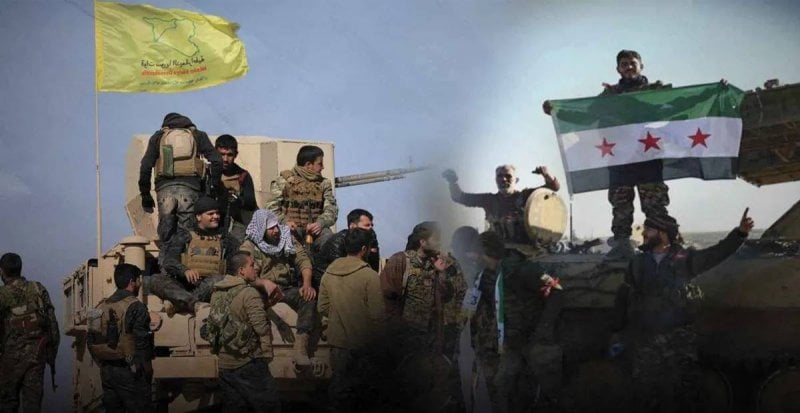
The relationship between the Syrian government and the Syrian Democratic Forces (“SDF”) is witnessing remarkable developments towards political and military rapprochement, through a series of meetings and field understandings that reflect a common desire to settle outstanding disputes.
After years of caution and testing intentions, it seems that the two sides have moved to the implementation phase, with indications of a gradual consensus on issues of sovereignty, security integration, and economic integration.
In the latest developments, a delegation from the Syrian government met with representatives of the “SDF” in the city of Al-Tabqa to discuss the recent events in the Sheikh Maqsoud and Ashrafieh neighborhoods in Aleppo. Following the meeting, the “SDF” announced the handover of a number of detainees to the Syrian government, while emphasizing the importance of continuing the dialogue to ensure stability and the unity of Syrian territory.
This meeting came after practical steps embodied in the “SDF’s” willingness to cooperate with Damascus on sensitive issues, such as handing over oil production from the Deir ez-Zor fields to the Syrian government, based on verbal understandings between President Ahmed Al-Shara and “SDF” commander Mazloum Abdi during a meeting between them in Damascus last week.
These understandings indicate that the “SDF” will retain a percentage of production to meet the needs of the local market, while the government will manage the fields as part of a comprehensive plan to reintegrate the northeastern regions into state institutions.
Local sources report that the process of integrating the areas under the control of the “SDF” will begin from Deir ez-Zor, and in its first stages includes oil fields and civil institutions, then military and security forces, paving the way for a more comprehensive path.
However, this path faces real challenges related to the structure of the “SDF” and the diversity of its ethnic and organizational components.
The issue of the “SDF” joining the Syrian army is one of the most sensitive issues between the two sides, and constitutes a real test of the two parties’ will to build unified institutions that transcend national or partisan affiliations, according to observers.
In this context, Siban Hamo, a member of the General Command of the Syrian Democratic Forces and a member of the military committee for negotiating with Damascus, affirmed the “SDF’s” readiness to join the Syrian army, provided that the integration is based on foundations that respect its specificity and identity and guarantee the rights of all components of the Syrian people.
For his part, Syrian Foreign Minister Asaad Al-Shaibani affirmed that the “SDF’s” joining the national army is the right way to serve the supreme national interest, which indicates Damascus’ support for the option of integration rather than parallelism.
Political and strategic expert Abdul Jabbar Al-Okaidi explained that there is a real desire within the “SDF,” especially among national Kurds, to activate the March 10 agreement signed between President Ahmed Al-Shara and Mazloum Abdi, and to end the existing disputes.
Al-Okaidi pointed out that the appointment of Siban Hamo to the joint military committee is a strong indication of this trend, describing him as an open-minded leader who understands the nature of Syrian society and the national army.
Al-Okaidi believes that the talk should be about “integration” and not “joining,” explaining that integration means restructuring the Syrian army in a way that allows the “SDF” to be absorbed into its structure, while joining suggests a bloc joining another without internal change in the overall structure.
Al-Okaidi affirms that the desired Syrian army must be a comprehensive national one, comprising Arabs, Kurds, Christians and all components, without turning into sectarian or ethnic formations.
He pointed out that the activation of the agreement has already begun by addressing the disputes in the Ashrafieh and Sheikh Maqsoud neighborhoods of Aleppo, where a number of detainees who were being held in Raqqa and Deir Hafer were released, describing this step as a positive indication of the progress of the talks.
Al-Okaidi stressed that achieving integration requires mutual concessions and a mature political vision, warning that any model of quotas or ethnic and sectarian division will not build a real state, but will deepen division.
He pointed out that some hard-line Kurdish currents affiliated with the “Kurdistan Community” system – such as the Kurdistan Workers’ Party in Turkey and the Democratic Union Party in Syria – may hinder some aspects of the agreement, while the openness of the Syrian leadership and national Kurdish leaders such as Mazloum Abdi and Siban Hamo enhances the chances of reaching a comprehensive understanding.
Al-Okaidi concluded by emphasizing that “any drop of Syrian blood is precious to everyone,” calling for the integration to be the beginning of a comprehensive national project that restores Syria’s stability and unity.
Damascus and the “SDF” today appear to be on the verge of a new stage of understanding, in which each party tests its ability to compromise and adapt to a national partnership that transcends narrow calculations.
The field meetings, the handover of detainees and oil, and the opening of political channels are all indications that the page of estrangement has begun to be turned gradually, to be replaced by a more realistic formula entitled “Integration for the sake of the state.”
But the road is still long; The field alone will determine whether this rapprochement is merely a temporary truce or a real step towards rebuilding Syria on new foundations of partnership and a unified identity.
source: 961 today