The World Bank issued a report on Tuesday entitled “Assessment of Physical Damage and Reconstruction in Syria (2011–2024),” in which it estimated the cost of rebuilding Syria after more than fourteen years of war at about US$216 billion.
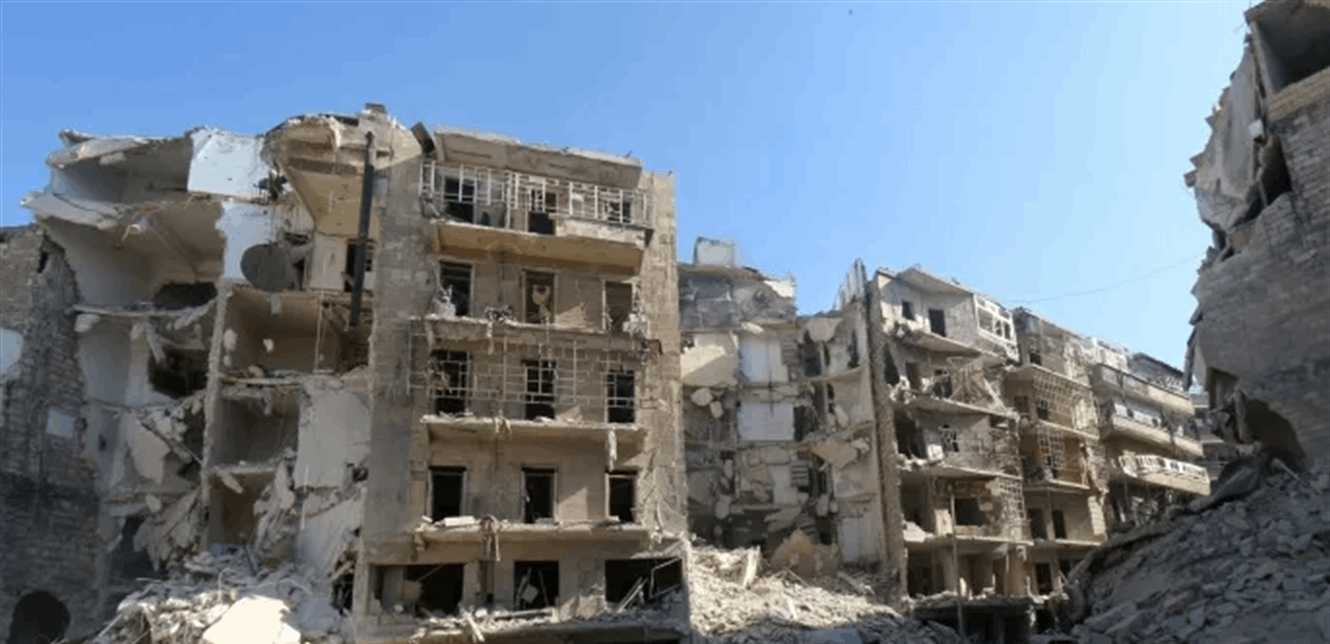
The report indicated that nearly one-third of fixed productive assets have been damaged since the beginning of the conflict, and that direct physical losses to infrastructure and residential and non-residential buildings amounted to about $108 billion.
The report showed that infrastructure is the most damaged sector, with damages amounting to about $52 billion, or 48% of the total damage, followed by residential buildings at $33 billion, and then non-residential buildings at $23 billion.
The report stated that the governorates of “Aleppo,” “Rif Dimashq,” and “Homs” were the most affected among the Syrian governorates.
The report also estimated that the cost of reconstruction ranges between $140 and $345 billion, with an average of $216 billion, distributed as follows: $75 billion for the residential sector, $59 billion for the non-residential sector, and $82 billion for infrastructure. The report indicated that “Aleppo” and “Rif Dimashq” need the most investment.
The report quoted Jean-Christophe Carret, the World Bank’s Middle East Director, as saying: “The challenges ahead are enormous, but the Bank is ready to work alongside the Syrian people and the international community to support recovery efforts.” He stressed that collective commitment and coordinated action are the foundation of a long-term development path. He pointed out that the cost of reconstruction exceeds Syria’s projected GDP in 2024 by about 10 times, which illustrates the magnitude of the economic challenge.
The report explained that real GDP has decreased by about 53% between 2010 and 2022, and that nominal output has decreased from $67.5 billion in 2011 to about $21.4 billion expected in 2024. The Syrian Minister of Finance, Muhammad Yusr Barnieh, considered that the report represents a “baseline” for understanding the extent of the destruction, and called on the international community to mobilize efforts to restore infrastructure, revive communities, and lay the foundations for a more resilient future. (“Al Jazeera”)
source: 961 today