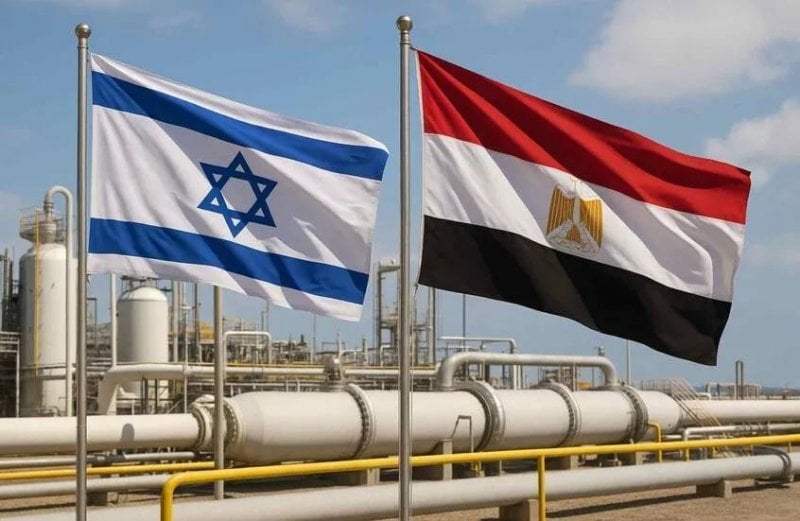
A recent study issued by the International Institute for Strategic Studies, and published by the Israeli news website “Natsif Net,” showed that the gas agreement between Egypt and Israel constitutes “a cornerstone for maintaining regional stability and ensuring the continuation of the peace agreement between the two countries for as long as possible.”
This study was prepared by researcher Alexander Mellon, a specialist in Middle East energy affairs and regional security policies, under the title: “Effective Interconnection: The Gas Deal between Egypt and Israel,” where he analyzed the potential profits and risks of this major agreement.
The study also explained that this deal has created a unique model of economic and security interdependence, where Israel supplies gas through the “Tamar” and “Leviathan” fields, while Egypt provides the necessary infrastructure for liquefaction and export through the “Idku” and “Damietta” centers, which puts the two countries in a position of mutual dependence:
Egypt relies on the flow of gas from Israel.
Israel relies on Egypt’s ability to liquefy and export gas to Europe.
Cairo benefits from this agreement by strengthening its position as a regional energy center and consolidating its presence in the European market, in addition to the fact that the revenues contribute to supporting foreign exchange reserves in light of the dollar crisis the country is suffering from.
For its part, Israel benefits from indirect access to European markets without the need to build new liquefaction facilities, which enhances its position as a reliable energy supplier in the Eastern Mediterranean region.
The study describes this agreement as a political and economic tool at the same time, as it enables Cairo to maintain open channels of communication with both Washington and Tel Aviv, while Europe sees it as a model for regional integration and a tool to ensure energy security and political stability.
Despite these gains, the study warned that this interdependence may be fragile in times of crisis, as any security, political, or technical defect may lead to shared damage, which calls for the establishment of long-term stability mechanisms.
At the end of the report, Mellon pointed out that the major gas deal was signed in the midst of the war in Gaza, explaining that Israel had concluded the largest gas export agreement in its history with Egypt worth $35 billion through the “NewMed Energy” company, considering that Egyptian-Israeli cooperation in the field of energy has gone beyond the economic dimension to become a regional alliance of interests.
source: 961 today