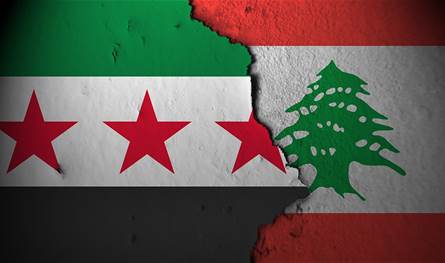
The British Broadcasting Corporation (BBC) published a new report on the new relationship between Lebanon and Syria, speaking of “distrust in light of efforts to open a new page between the two countries” in light of the presence of thorny issues.
The report says that “there has always been severe tension in relations between the two countries, not obscured by repetitive political slogans and exaggeration in expressing the depth of their relations,” and added: “Over the decades, especially under the Assad family’s rule of Syria, those relations were marred by multiple problems, reaching the point where Syria extended its political and military influence over Lebanon, for more than two decades. That influence did not end, except with International Resolution No. 1559, after the assassination of the former Prime Minister, the martyr Rafik Hariri, in 2005, and the subsequent Syrian withdrawal from Lebanon.”
He continued: “Years later, the first sparks of the Syrian war began, which proved once again the extent to which each of the two countries was affected by what was happening in either of them, starting with the influx of Syrian refugees into Lebanon, all the way to Hezbollah in 2013, its joining of the Syrian war, in support of the ruling regime in Damascus, and the major military and political consequences that this had.”
The report saw that “the fall of Bashar al-Assad’s regime and the assumption of the duties of government by the head of the transitional period in Syria, Ahmed al-Sharaa, did not end the contentious files between the two countries, although it allowed the opening of a new page between them – which is still unclear.” It added: “The most prominent outstanding files between the two countries are those related to Syrian prisoners in Lebanese prisons, the demarcation of the borders, and the issue of the return of Syrian refugees to “Their country.”
The report says, “Since the fall of Bashar al-Assad’s regime, the new officials in Syria have been demanding the release of Syrian and Lebanese detainees, who are classified as Islamists, from Lebanese prisons, or handing them over to the current Syrian authorities.” It added: “Although there are no accurate numbers for Syrian prisoners in Lebanon, estimates indicate that their number is about two thousand, a large portion of whom were arrested on charges related to supporting the revolution.” Formerly Syrian.”
He continued: “These are divided between convicts and detainees, and the charges against them range from misdemeanors to felonies, the most serious of which are those related to terrorism, or the killing of members of the Lebanese army, or Lebanese security elements. In practice, any solution to the file of these people will be the most difficult, with the Lebanese authorities refusing to release anyone imprisoned on these charges.”
He said: “It is scheduled that judicial agreements will be signed between Lebanon and Syria, which will contribute to dealing with the file of Syrian prisoners, while the issue of whether any agreement or settlement in this regard will also include Lebanese prisoners has not been confirmed. In this context, resolving their file may be part of what the Lebanese authorities say are plans being discussed to reform the judicial system in general and address prison conditions. Also, ideas have been put forward such as reducing The prison year is only 6 months and others, but it is an issue that will likely take a long time and create great controversy in Lebanon.”
The report considered that “the prisoner file, despite all the problems that plague it, remains easier than the file of demarcating the borders between the two countries,” and added: “This issue goes back to the 1920s, when the French determined the borders between the two countries without completely demarcating them, which opened the way for fallacies and the emergence of seemingly abnormal conditions on the borders between the two countries. Following the collapse of the Ottoman Empire a little more than a hundred years ago, “Both Lebanon and Syria were placed under French mandate.”
He continued: “This border extends about 375 kilometers between the east and the north, and in many areas there are overlapping areas between Syria and Lebanon. It is very difficult for anyone who visits them to know whether they are located on the Lebanese or Syrian side of the border. Also, the border region is characterized by the presence of rugged natural terrain of mountains, peaks, and rivers.”
He said: “The lack of demarcation of the borders and the existence of different maps regarding them led to the outbreak of disputes over lands, most notably the Shebaa Farms area. However, Lebanon says that this area is Lebanese, while the statements of former regime officials in Damascus regarding its identity contradicted it, between Lebanese and Syrian. Also, Israel has occupied this area since 1967, and considers it part of the Syrian Golan, while Lebanon demands that Israel withdraw from it, as it is considered territory.” Lebanese.”
He explained that “the overlapping borders allowed the spread of the phenomenon of smuggling goods between Lebanon and Syria, and the spread of a large number of illegal crossings, which are also used to smuggle drugs, weapons, and other contraband.”
As for the other file, which Lebanon considers to be a priority to address, it is the issue of Syrian refugees in the country, and he added: “Hundreds of thousands of Syrians took refuge in Lebanon to escape the Syrian war and what they said was persecution from the previous regime, which turned Lebanon into the country with the largest number of refugees in the world compared to its population. However, the Lebanese authorities say that their presence in the country for long years constituted a major economic and demographic burden on Lebanon, which wants them to return to Syria, especially after the situation there has changed.”
He said: “In the recent period, the Lebanese-Syrian border has witnessed an active movement of Syrians returning, and the Lebanese authorities and the United Nations High Commissioner for Refugees have taken a series of incentive steps to encourage them to return, but they are also betting on the cooperation of the new Syrian authorities with them, to accelerate the return of larger numbers of them.”
Related topics